

 Share
Share
8. Dec. 2025
Physicists from CEITEC Brno University of Technology have developed a new method capable of measuring the properties of short spin waves. These can be imagined as waves in magnetic materials that can transmit information. Short spin waves have the potential to find applications in a new generation of computing devices, such as chips for computers and phones. The newly developed method overcomes what was considered an insurmountable research barrier. The results of their several-year research have now been published in the prestigious journal Science Advances.
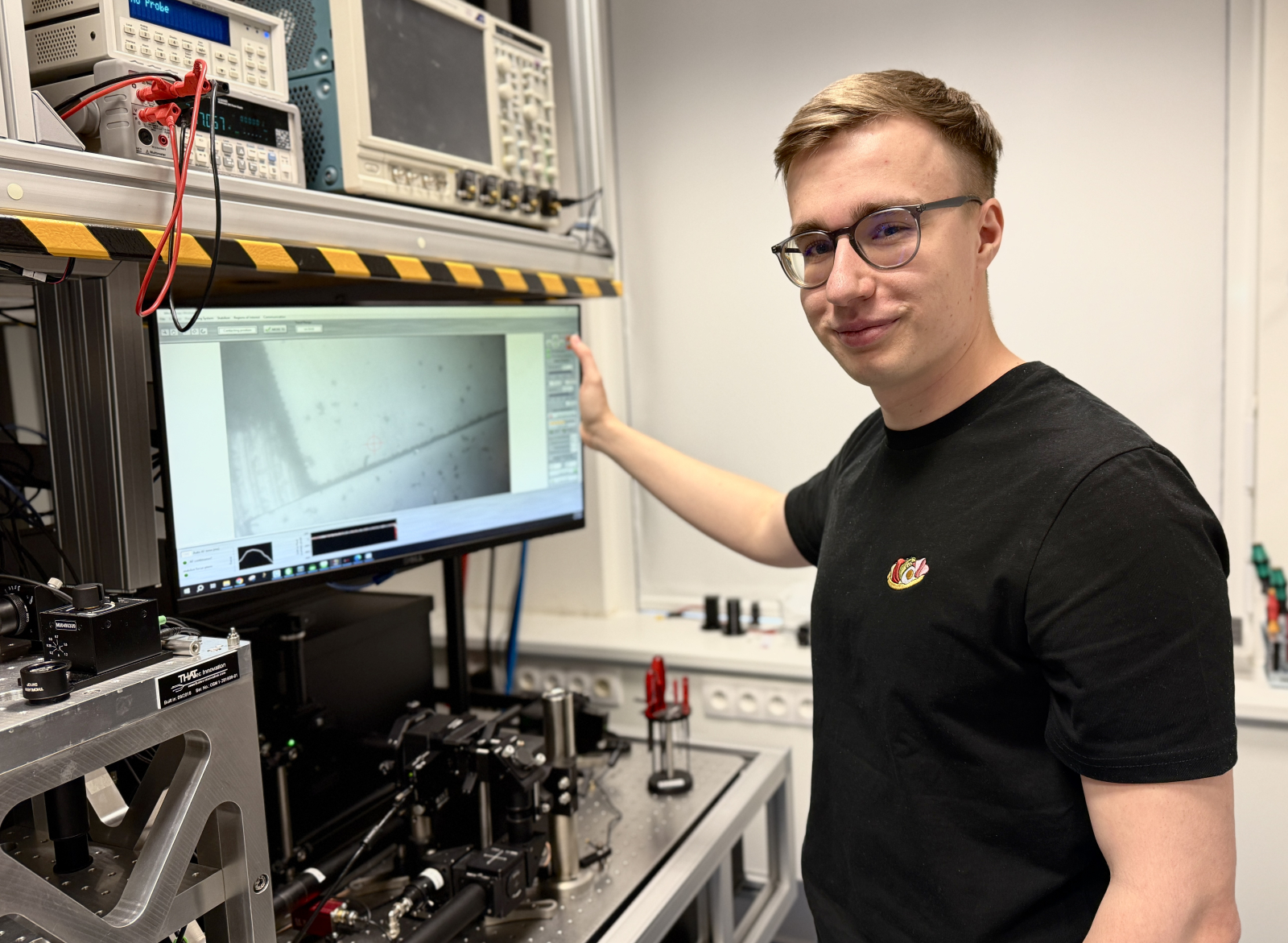
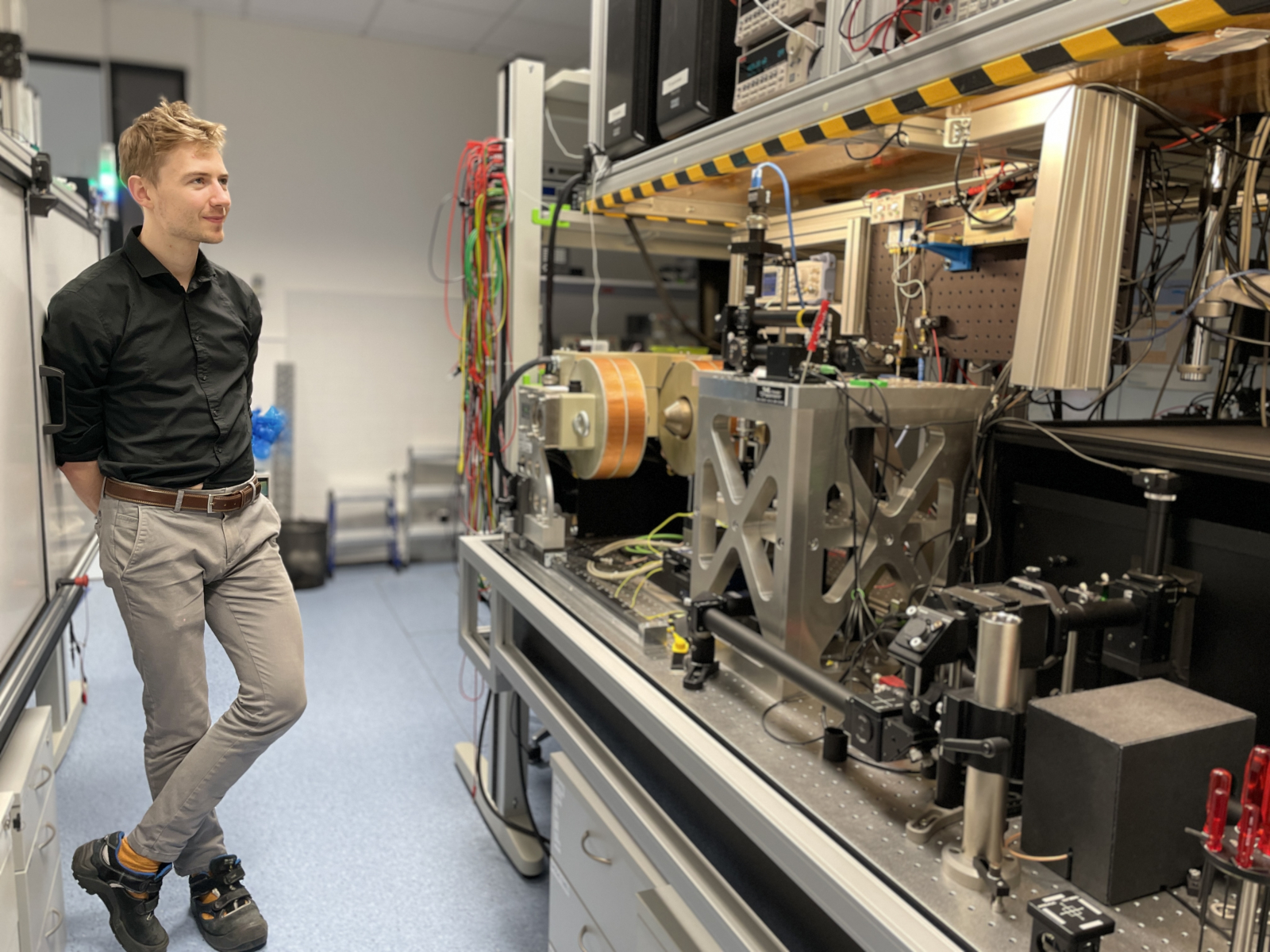
Jakub Krčma from the Faculty of Mechanical Engineering BUT and Ondřej Wojewoda from CEITEC BUT study magnonics – a physical discipline focused on spin waves. “We can imagine spin waves as the collective movement of many mutually interacting compass needles in a magnetic material. In other words, it is a wave that propagates through the interior of such a material and at the same time carries encoded information,” starts Ondřej Wojewoda, who is now working at the Department of Materials Science and Engineering (DMSE), MIT, US. To study spin waves, an optical technique known as Brillouin light scattering microscopy (µBLS) is used. We can imagine it as a laser magnifying glass: the objective focuses a laser onto a very small spot on the sample, and information about the material is read from changes in the light after interacting with it. But there is a catch: this “magnifying glass” has its limits. It works well only for observing waves with a wavelength of more than 300 nanometers; shorter spin waves cannot be measured this way.
300 nanometers, the µBLS limit, does not sound like a large number – after all, a nanometer is just a millionth of a millimeter, so we are roughly at the scale of some viruses. However, one must realize that in the context of modern electronics, 300 nanometers is multiple times larger than the size of a transistor in a modern chip. If we therefore consider the application of spin waves in modern electronics, we run into the limits of this method. Short spin waves, which are key for future chip miniaturization, simply cannot be measured.
The only option to measure shorter spin waves so far has been massive and expensive particle accelerators called synchrotrons, but even those were unable to capture short waves. Research thus ran into an impenetrable wall.
Mie BLS: a method that forced light to “change the rules of the game”
In the new study published in the prestigious journal Science Advances, the scientists described a new method, which they called Mie BLS, that removes this previously insurmountable barrier. The method involves placing very thin silicon strips (nano-resonators) on the surface of the sample, where they serve as “amplifiers” and “guiding lenses” for light.
“Using Mie resonance, we can focus and amplify light so that it is no longer constrained by its own wavelength. The nano-resonators act as intermediaries that allow light to communicate even with those shorter spin waves that were previously invisible,” explains Jakub Krčma.
“This procedure of ours is revolutionary in that it builds upon an already existing optical method and improves it so that we can now comfortably measure these short spin waves even while using standard laboratory equipment,” adds Ondřej Wojewoda. The researchers thus managed to break through a barrier that had long seemed insurmountable.
With the ability to observe and measure short spin waves, the door opens to the design and fabrication of so-called magnonic chips, where information transfer is based on short spin waves. These could fundamentally change the capabilities of computing technology, because they do not overheat. Spin waves do not carry electric charge, so they do not produce heat, unlike electric current. In addition, they consume up to twenty times less energy than today’s electronics, which is absolutely crucial at a time of ongoing discussions about the energy demands of modern technologies.
The method will also find use beyond computing technology – in materials science, biology, or diagnostics of microcracks in critical components, for example in the aerospace industry.
Author: Kristina Blűmelová
Photogallery
Expert
