 Share
Share
About event
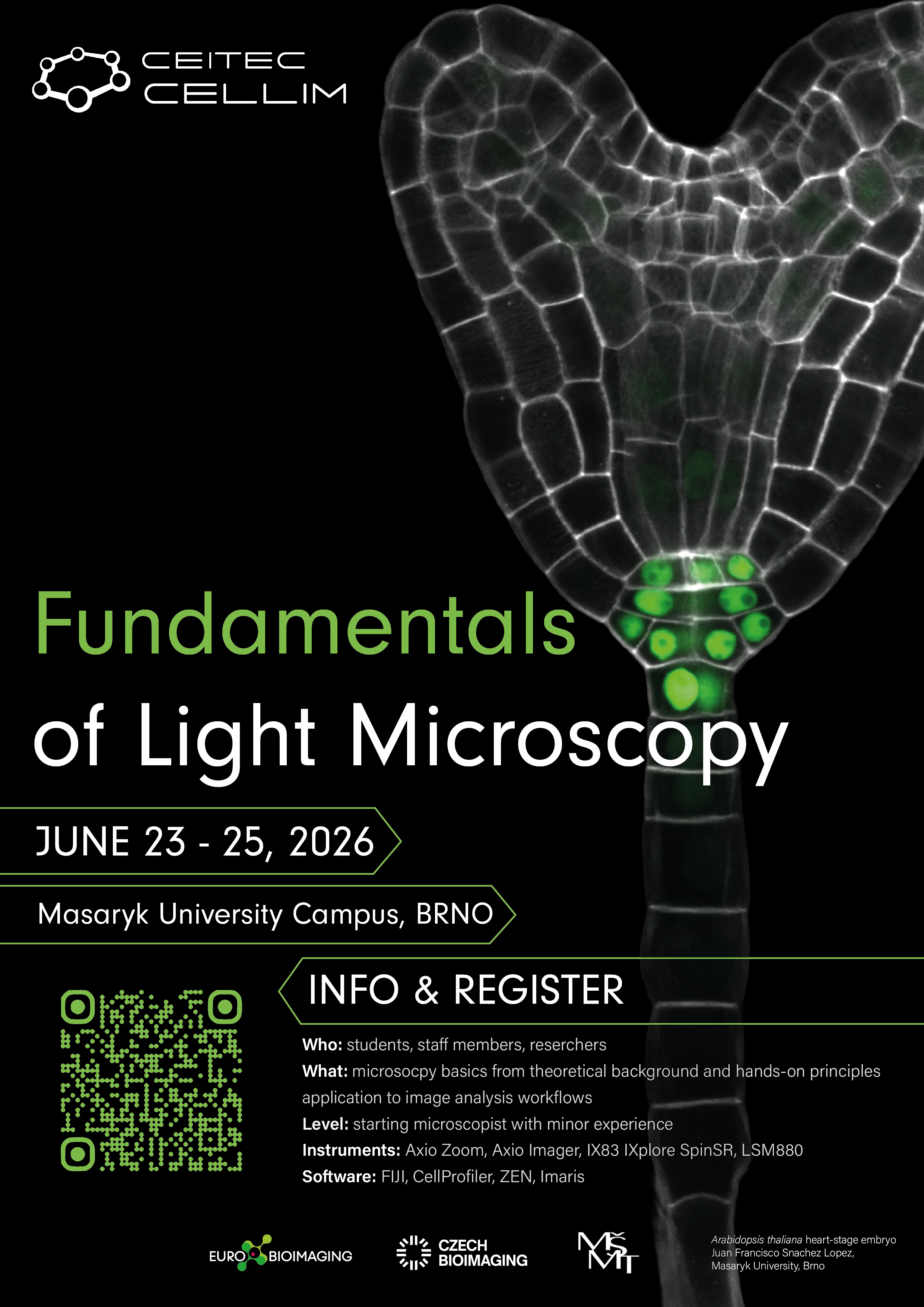
The Fundamentals of Light Microscopy is a basic course for students, postdocs, technicians, and other laboratory staff in biology and biomedical science who require widefield and/or confocal microscopy for their experiments. The course consists of theoretical lectures (50%) and practical hands-on session on selected microscopes and software (50%).
Overall, this course provides an introduction to the fundamentals of light microscopy, with a focus on understanding how images are formed and how acquisition choices affect resolution, contrast, and quantitative image quality. Participants will learn core principles including diffraction and the point spread function, numerical aperture and refractive index effects, sampling and digitization, detector characteristics and noise, and the conceptual differences between major imaging modalities such as widefield, confocal, super-resolution and light sheet microscopy.
A dedicated practical session will demonstrate the learned principles directly on real microscope acquisitions. Participants will gain skills needed to operate selected microscopes and experience how changing parameters influences contrast, optical sectioning, signal-to-noise ratio, and artifacts.
Finally, the workshop concludes with an introduction to basic workflows in image processing and analysis, including foundational steps for viewing, correcting, and preparing microscopy datasets for downstream quantification using open-source and commercial tools (FIJI/ImageJ, CellProfiler, ZEN, Imaris).
Practical training will be conducted on following systems:
Carl Zeiss AxioZoomV16 – fluorescence stereo microscope with Apotome module
Carl Zeiss AxioImagerZ2 – upright widefield microscope with Apotome module
Evident Yokogawa W1 – multi point laser scanning confocal microscope
Carl Zeiss LSM880 – single point laser scanning confocal microscope
Image processing and analysis software – ZEN, Imaris, ImageJ/FIJI, Cell Profiler
By the end of the course, participants should be able to:
Core principles of image formation & optical performance
- Explain how microscope images are formed and how this relates to magnification, resolution, and contrast.
- Describe key properties of light relevant to microscopy.
- Interpret diffraction concepts and the role of the Airy pattern/PSF in resolution.
Objectives, refractive index, and resolution limits
- Explain the role of numerical aperture (NA) and wavelength to reason in diffraction-limited resolution.
- Be able to read the objective specifications and apply the information to objective selection.
- Explain refractive index and refraction and their influence on image quality.
- Apply practical rules for coverslips and mounting media.
Contrast methods in transmitted-light microscopy
- Describe transmitted light optical path and relevance of field illumination.
- Compare transmitted-light modalities (brightfield, darkfield, phase contrast, DIC).
- Choose an appropriate method based on sample type and desired contrast.
Fluorescence microscopy principles
- Explain fluorescence basics (e.g., excitation/emission, Stokes shift, Jablonski diagram)
- Describe essential components of simple fluorescence microscope.
- Recognize main light sources in fluorescence microscopy and their main trade-offs.
- Explain what filters/beam splitters do, and diagnose common multicolor issues like bleed-through/crosstalk.
- Identify major microscope modalities for fluorescence imaging and the main trade-offs.
Detectors and digital image formation
- Describe common detector types and match detector choice to the imaging modality.
- Explain ADC/bit depth and how digitization affects dynamic range and quantification.
- Identify major noise sources and how acquisition settings influence Signal to Noise Ratio.
Confocal microscopy principles and parameter tuning
- Explain how confocal optical sectioning works and how pinhole size (Airy units) affects signal, optical thickness, and resolution.
- Compare multicolor acquisition strategies (sequential vs simultaneous vs lambda imaging) and explain their main trade-offs.
Optical sectioning alternatives & volumetric imaging
- Explain structured-illumination optical sectioning (Apotome-style).
- Describe the light-sheet optical sectioning principle.
- Summarize the idea of “resolution below the diffraction limit” and differentiate major super-resolution families.
Image processing and analysis
- Explain main digital image characteristics and its formation.
- Select and apply the appropriate basic image processing methods to fluorescence images.
- Perform simple segmentation and feature extraction protocols.
- Choose appropriate image and statistics visualization within selected software.
Practical workflow skills
- Perform basic experiment acquisition on stereo, widefield, and confocal system.
- Recognize components of a microscope and select appropriate setup for brightfield and confocal imaging.
- Use histogram-based reasoning to set exposure and recognize saturation as a data-quality problem.
- Apply Nyquist/Shannon sampling ideas to select pixel size/binning appropriately and avoid over/under-sampling.
- Adjust key confocal acquisition parameters (pinhole, gain, pixel dwell time, averaging, pixel count/bit depth) to balance image quality vs photobleaching/phototoxicity.
- Use basic digital image-processing software tools (FIJI/ImageJ, ZEN, Imaris) for foundational viewing/processing tasks aligned with microscopy acquisition.
Programme
PRELIMINARY PROGRAMME:
Day 1: Theoretical introduction to basic microscopy concepts
Day 2: Hands-on session on selected microscopes (part 1)
Day 3: Hands-on session on selected microscopes (part 2) and image analysis software
More information
PARTICIPANTS: Limited number (12), will be accepted on the first-come-first-served base
LEVEL/PREREQUISITE: Starting microscopist with minor experience (next level: Advanced Light Microscopy Methods)
COSTS (including coffee breaks and refreshments):
- Academic: 1, 200 CZK + VAT,
- Commercial: 3, 300 CZK + VAT
INFO & CONTACT: