 Share
Share
About Event
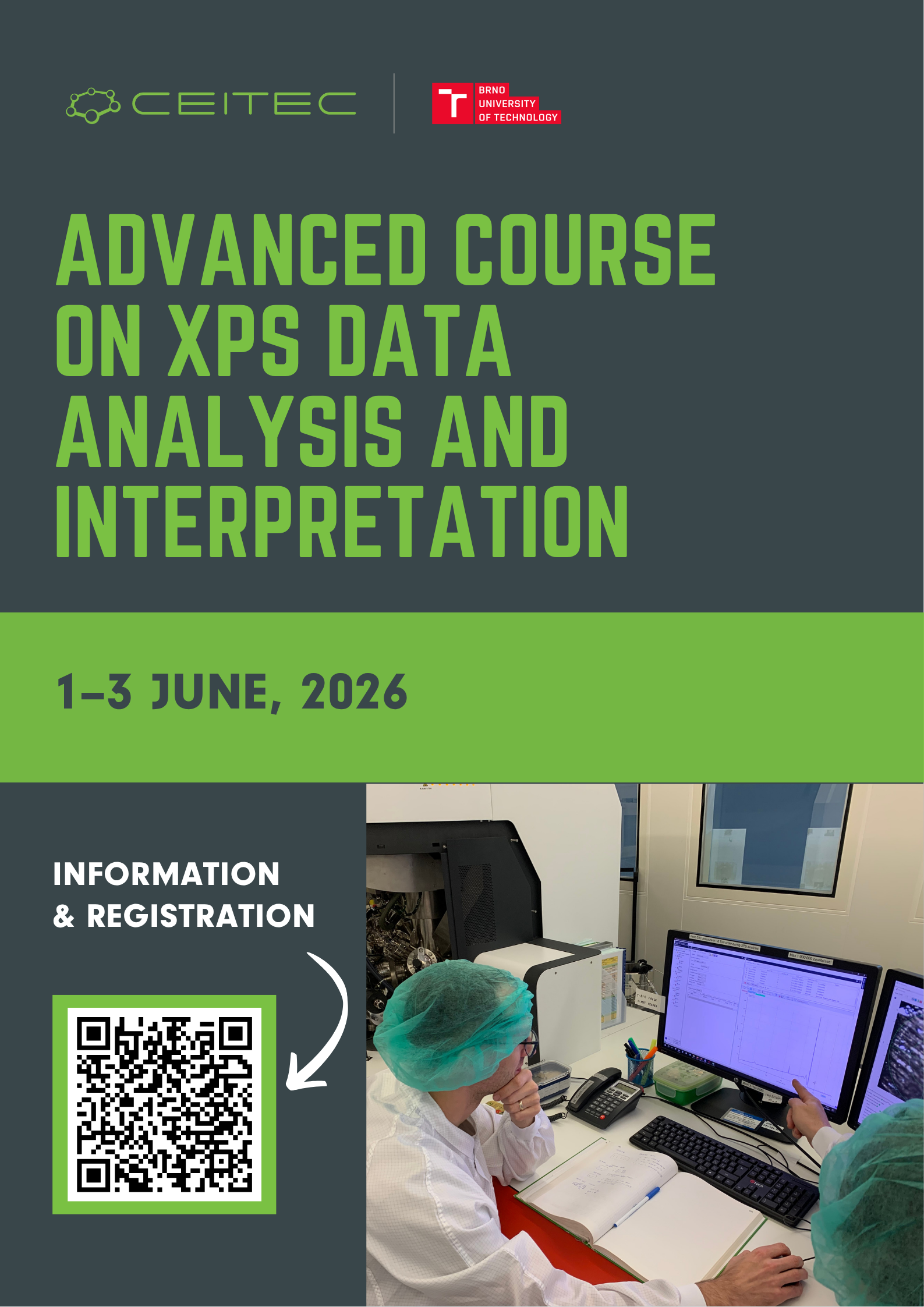
Learn how to analyze and interpret your XPS data correctly with XPS Masters.
While the development of X-ray photoelectron spectroscopy instruments has led to their accessibility and ease of data collection, the analysis and interpretation of measured data remain challenging. In recent years, the share of incorrect analyses in the scientific literature has reached 60%, according to a recent survey, while an XPS expert recognizes flaws at a glance. The primary reason is the lack of proper education; to remedy this situation, we introduce a 2-and-half-day advanced course designed to provide the necessary core knowledge on the XPS technique, data analysis, and interpretation.
About the lecturer
Jan Čechal is a professor of applied physics and leader of the research group Molecular Nanostructures at Surfaces at CEITEC, Brno University of Technology. He has 25 years of experience in surface analysis, particularly XPS, including synchrotron radiation measurements. He made a significant contribution to establishing the XPS in the CEITEC Nano Core Facility. He is a coauthor of three perspective/guidelines papers on XPS:
- Perspective on improving the quality of surface and material data analysis in the scientific literature with a focus on X-ray Photoelectron Spectroscopy (XPS) by Major et al., J. Vac. Sci. Technol. A 41 (2023), 038501;
- Avoiding Common Errors in X-ray Photoelectron Spectroscopy Data Collection and Analysis, and Properly Reporting Instrument Parameters by Pinder et al., Appl. Surf. Sci. Adv. 19 (2024), 100534; and
- Essential Principles and Practices in X-ray Photoelectron Spectroscopy by Čechal, arXiv (2025), 2512.24756.
The course fee
- Introductory price: 6000 CZK/participant
(Regular fee 400 €/participant is reduced to 240 €/participant for the course held in June).
What is included
- Course materials and slides from presentations.
- Coffee breaks and lunch.
- Certificate of attendance.
What to bring
- Your own computer for tutorials.
Programme
The course presents a balanced mix of lectures (L) and hands-on tutorials (T) on the analysis of the provided data.
Day 1:
- 8:30 – 9:30 Lecture 1: Introduction to XPS and overview of core knowledge
Coffee break
- 9:50 – 11:10 Lecture 2: Principles of XPS and anatomy of the spectrum
- 11:10 – 12:40 Tutorial 1: Reading the spectra
Lunch break
- 14:00 – 15:30 Lecture 3: Going deep in the core level shifts
- 15:30 – 16:00 Tutorial 2: Peak Fitting
Day 2:
- 8:30 – 9:30 Tutorial 2 (continues): Peak Fitting
Coffee break
- 9:50 – 11:20 Tutorial 2 (continues): Peak Fitting
- 11:20 – 12:10 Lecture 4: Quantitative analysis
Lunch break
- 13:30 – 14:30 Tutorial 3: Quantification
- 14:30 – 16:00 Lecture 5: Electron transport in solids and depth profiling
Day 3:
- 8:30 – 9:30 Tutorial 4: Layer thickness determination, SESSA
Coffee break
- 9:50 – 10:50 Lecture 6: Instrumentation charge compensation and referencing
- 10:50 – 12:00 Tutorial 5: Spotting inconsistencies in the spectra, concluding discussion
More information
To provide full personal support to the participants during the tutorial session and space for discussion, the number of participants on each course is limited. The course will be repeated monthly or according to demand.
References
"The two-day advanced XPS course was well organized and informative, with a good balance between theory and practical aspects. The instructor showed strong expertise, explained complex concepts clearly, and encouraged interactive discussions that enhanced understanding."
Sayed Hossein Mirdamadi, CEITEC, Brno University of Technology
"I am a bit of an experienced user, but I also appreciated your course a lot. It is structured very well, to be useful for both beginners and more experienced users. The XPS world was covered under every aspect, also to be useful for a variety of applications. I also found the tutorials part fundamental and very well organized. Honestly, I didn't find any improvements needed."
Nicolò Rossetti, CEITEC, Brno University of Technology
"I would highly recommend this advanced course on XPS data analysis and interpretation to anyone working with XPS. From my perspective, the course provided an excellent combination of a thorough theoretical background and intensive hands-on training, which significantly deepened my understanding of spectral interpretation, peak-fitting strategies, and quantitative analysis. The course helped me refine my own approach and gain better insight into interpreting XPS spectra."
Pavlína Peikertová, VSB - Technical University of Ostrava, Czechia
"The course included a variety of basic and advanced concepts of XPS. Not only did we go through fundamental theoretical knowledge, but we also discussed several practical examples of different materials that can be encountered in laboratory life. Therefore, it was well-balanced for users of different expertise. We also tried working with different software that is either freeware or generally available at Universities. Overall, I recommend the course to all researchers working in the field of materials and surface science."
Luca Mascaretti, Regional Centre of Advanced Technologies and Materials, Olomouc, Czechia
"I found the course extremely useful and well structured. The lectures and discussions helped me significantly improve my understanding of both the fundamentals and the advanced aspects of XPS data acquisition and interpretation.Thank you also for your kind offer to discuss individual data and results. I truly appreciate your willingness to provide further guidance, and I will certainly contact you as I continue working on my data. I am confident that this will help me gain more confidence in XPS data interpretation. Once again, thank you for an excellent course and for your support.Aiswarya Vijayakumar Thelappurath. Institute of Physics of Materials, Czech Academy of Sciences, Brno, CzechiaI thoroughly enjoyed the Advanced Course on XPS Data Analysis and Interpretation. I highly recommend it to anyone who plans to work with XPS. The course content was very interesting, useful, and also inspiring for my future work in this field. I greatly appreciate the combination of theory, practical data‑processing examples, and the excellently prepared presentations."
Štěpánka Kelarová, Department of Plasma Physics and Technology, Masaryk University, Brno, Czechia
- Would you like to have this course at your institution? Feel free to contact Jan at Jan.Cechal@ceitec.vutbr.cz.