 Share
Share
About event
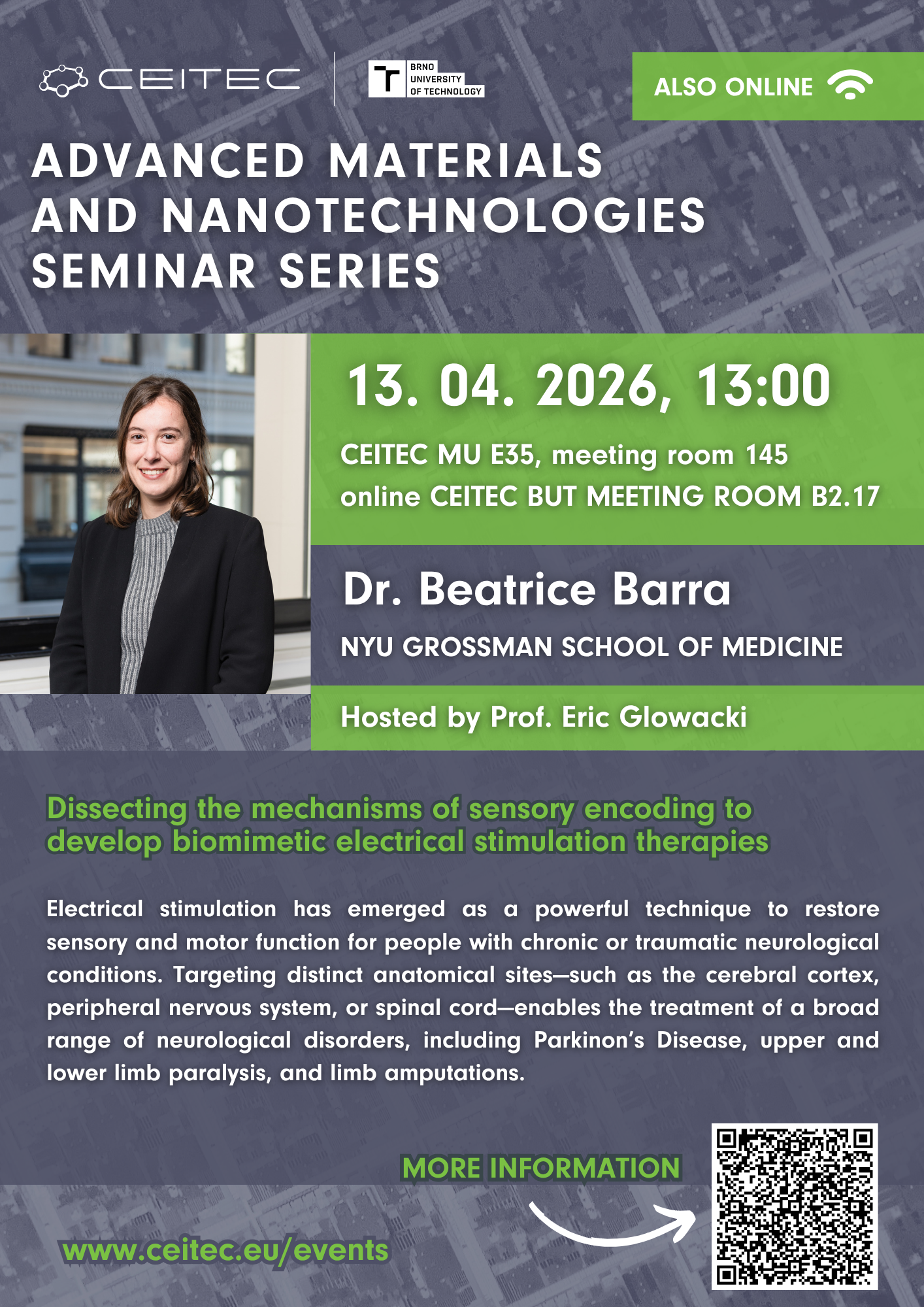
Dissecting the mechanisms of sensory encoding to develop biomimetic electrical stimulation therapies.
Electrical stimulation has emerged as a powerful technique to restore sensory and motor function for people with chronic or traumatic neurological conditions. Targeting distinct anatomical sites—such as the cerebral cortex, peripheral nervous system, or spinal cord—enables the treatment of a broad range of neurological disorders, including Parkinon’s Disease, upper and lower limb paralysis, and limb amputations. However, many of these groundbreaking approaches face significant challenges in translation to clinical practice and everyday life, as they tend to generate movements or sensations that do not feel natural or intuitive to patients.
I my research, I focus on studying how the brain encodes sensory stimuli, with the aim of developing biomimetic stimulation approaches—that is, stimulation protocols that artificially reproduce the normal patterns of activity of the nervous system. Here, I will first introduce a biomimetic stimulation approach that evokes more natural percepts by inducing naturalistic firing patterns. Combining a biophysically-realistic computational model, single-unit electrophysiological recordings and human experiments we show that amplitude modulated high-frequency sinusoids elicit neural firing that better resembles natural firing compared to traditional electrical stimulation waveforms.
These results represent an important step towards the development of biomimetic stimulation strategies to restore sensory feedback in clinical applications. Second, I will show how investigations in human and animal models can be coupled to study how the intensity of sensation is encoded in the brain. Using olfaction as a model system, I combined cutting-edge behavioral assays with electrophysiology recordings in both mice and humans to unravel how odor intensity information is encoded along the sensory processing pathway. Our results suggest that mice and humans evaluate odor stimulus strength using common psychophysical principles and that intensity information is encoded by the synchronization of cortical activity. Together, these lines of research advance our understanding of sensory encoding and lay the groundwork for next‑generation biomimetic neurostimulation strategies that can restore more naturalistic perception and function in people with neurological conditions.