

 Share
Share
How can a manufacturing operation that still requires manual handling be automated without first interfering with the actual production process? As part of the EDIH programme, we worked with DMT Jelínek to assess the feasibility of automating the loading of parts into a semi-automatic welding system. While the welding process itself was already automated, individual assemblies still had to be manually loaded into the machine by an operator. The aim was to design and validate a solution in which this repetitive task would be performed by an industrial robot, paving the way for further automation of the production process.
- Client: DMT Jelínek
- Year: 2024
- Project duration: 2 months
Solution
From the real workplace to a digital twin
The first step was to accurately capture the existing production workplace using 3D scanning. The area was scanned with a Faro S350 scanner, while detailed sections were measured using a Hexagon AS1 Absolute Scanner. The acquired data were processed and transferred into the Tecnomatix simulation environment, where a digital twin of the actual workplace was created. An ABB IRB 4600-40/2.55 robotic manipulator was then integrated into the virtual model. The simulation made it possible to verify the robot's reach, motion trajectories, access to the required positions, and potential collisions with surrounding equipment. This allowed the proposed solution to be safely tested before making any changes to the actual production environment.
Validation through a real-world experiment
The virtual simulation was complemented by a practical experiment at RICAIP Testbed Brno. Since it was not possible to relocate the semi-automatic welding system or install the robot directly at the client's site, 3D-printed test fixtures were created to simulate the parts magazine and the spindle of the welding system. The physical robotic workstation was then used to validate the entire process of gripping, handling, and loading the parts. The experiment also compared two-finger and three-finger Schunk pneumatic grippers. The three-finger self-centring gripper proved to be the more suitable option, as it better accommodated the cylindrical shape of the parts and the way they needed to be inserted into the welding system.
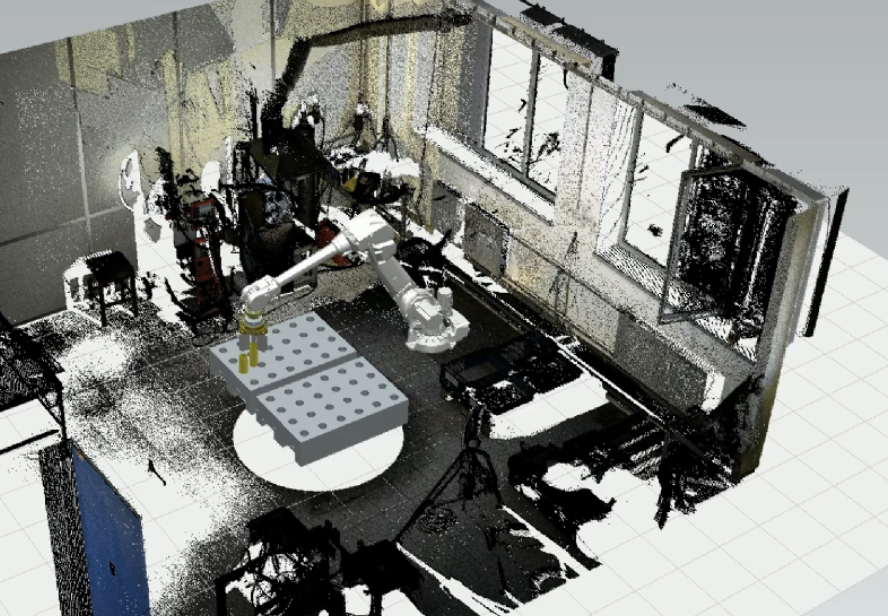
Digital twin of the workstation incorporating a scanned point cloud from the actual production environment
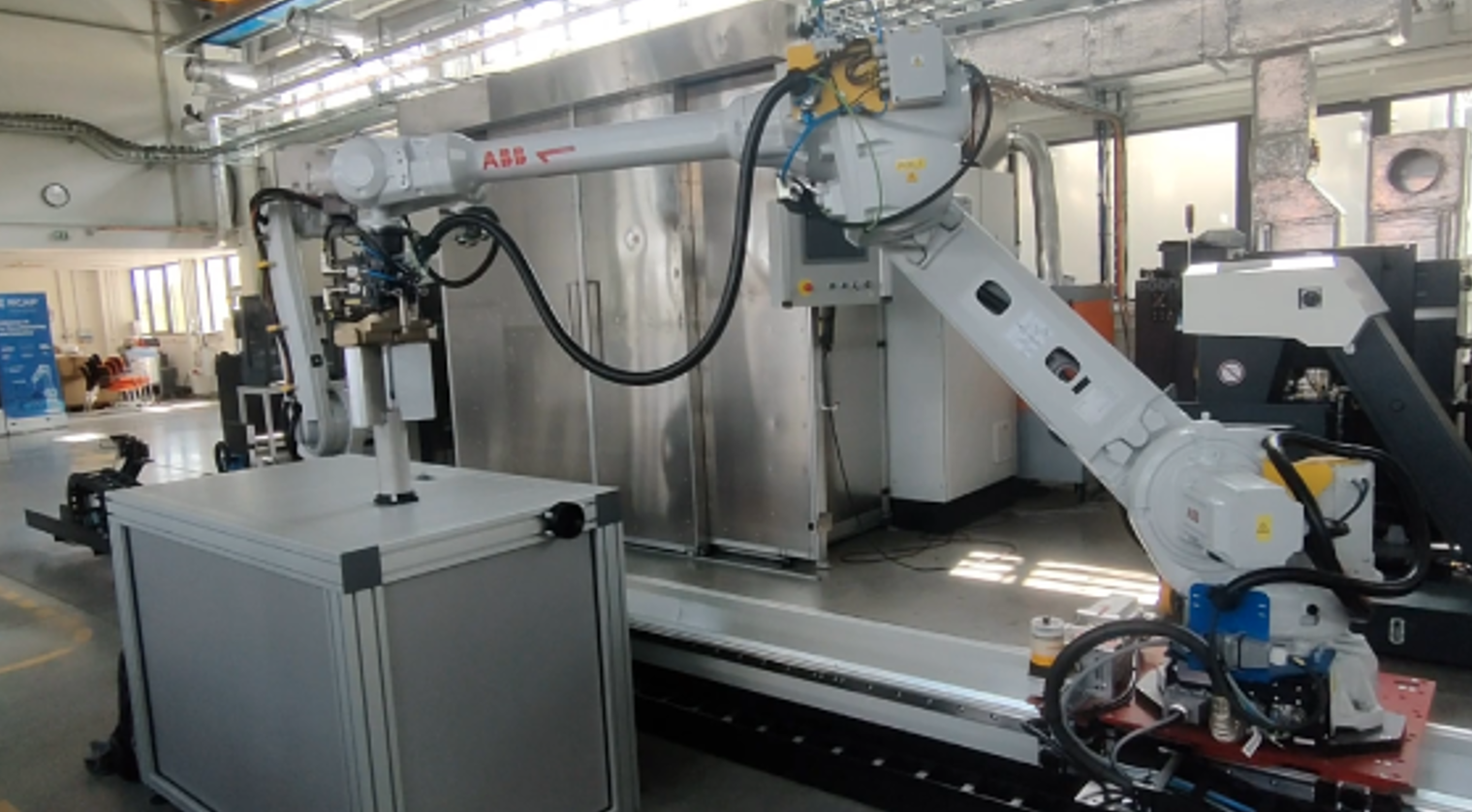
Experiment involving the placement of parts into a workstation mock-up
Results
The combination of a digital twin and a physical experiment confirmed that robotic loading of parts into the existing semi-automatic welding system is technically feasible. The project verified a suitable layout for the robotic workstation, the required reach and payload of the robot, the loading trajectories, and the method of gripping the parts. The study provided DMT Jelínek with a concrete technical basis for the potential implementation of an automated workstation while identifying the key requirements and possible limitations of the solution in advance.
Benefits of the Solution
Automating this repetitive handling operation can reduce the need for manual intervention at the welding workstation, improve workplace ergonomics, and contribute to a smoother and more efficient production process.
At the same time, the use of a digital twin makes it possible to virtually validate proposed changes before their physical implementation. This reduces the risk of unsuitable designs, collisions, or additional modifications when introducing automation into production.
Potential Applications
A similar approach can be used to automate and robotise other manufacturing workplaces, particularly where operators repeatedly handle parts with clearly defined dimensions. Digital twins can be used to verify the positioning of robots and production equipment, check robot reach and potential collisions, design handling trajectories, select suitable robots and grippers, and optimise production processes before physical implementation. The combination of 3D scanning, simulation, and experimental validation is also suitable for modernising existing production facilities where new automation solutions need to be integrated with existing technologies and spatial constraints.
Technologies Used
- 3D scanning: Faro S350, Hexagon AS1 Absolute Scanner
- Digital twin and simulation: Tecnomatix 16.1.2 (Siemens)
- Robotic manipulator: ABB IRB 4600-40/2.55
- Grippers: Schunk PGN+P240-1-SD and Schunk PZN-plus 200-1-SD
- 3D printing: Fortus 450mc, Prusa printers
- Data processing: PC-DMIS, RealWorks 12.1
Implementation
The project was carried out within the EDIH programme in cooperation with RICAIP Testbed Brno, CEITEC BUT.
