 Share
Share
About Event
Low-energy electron diffraction (LEED) is a widely used surface-sensitive technique, employed by a large fraction of surface physics groups. LEED measurements can usually be performed without much impact on the sample and are a quick way to obtain qualitative data about the surface structure. Furthermore, LEED optics are comparatively cheap. These properties make LEED an excellent supporting technique that can be used as a quick check to ensure that the sample surface is indeed the desired structure for a measurement.
Beyond the qualitative information that is contained in the LEED pattern, the intensity variation of the diffraction spots encodes information about position, chemical nature, and vibrations of each atom in the unit cell. By acquiring multiple LEED patterns at different beam energies, one can obtain quantitative data by extracting the intensity curves of the diffraction spots [LEED I (V)]. The extracted curves can then be compared to calculated curves for theoretical predictions of the sample surface. Such comparisons allow fitting the theoretical model to the acquired data with picometer accuracy. This makes LEED one of the most precise surface science techniques. Furthermore, LEED-I(V) data are valuable fingerprints, useful to ensure equal preparation in different vacuum systems.
Despite these advantageous properties, LEED is rarely used to its full potential. The main reason is the difficult and time-consuming data evaluation and, in the case of LEED I(V), the data acquisition process. This summer school will introduce attendees to modern, free-to-use software that significantly speeds up and improves LEED and LEED-I (V) data acquisition and evaluation.
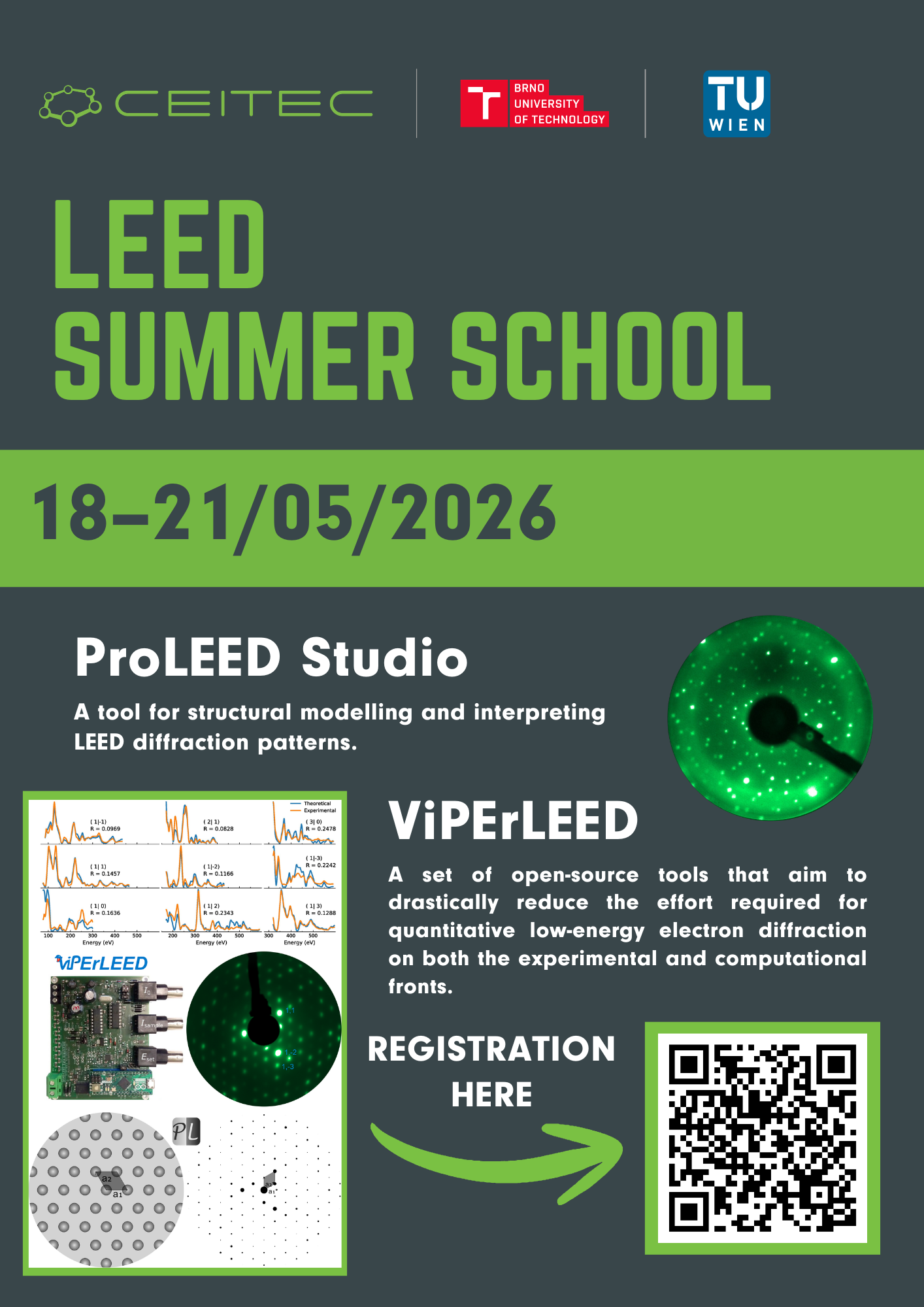
ProLEED Studio
ProLEED Studio is an intuitive tool for modelling and interpreting LEED diffraction patterns, designed to allow simple, precise, and interactive reconstruction of 2D unit cells from experimental images. It enables users to load experimental LEED images and interactively reconstruct the underlying 2D unit cell by manipulating lattice vectors and diffraction spots directly in real and reciprocal space. The software supports complex superstructures, multiple rotational or mirror domains, and commensurate or incommensurate lattices, and visualizes unit cells, grids, domains, and scale bars in real time.
During the workshop, participants will learn how to:
- import experimental LEED patterns and align them with modelled diffraction patterns;
- identify substrate and superlattice periodicities;
- construct 2D unit cells using drag-and-move manipulation in both real and reciprocal space;
- model multi-domain superstructures and Moiré patterns;
- adjust spot sizes to mimic experimental intensities;
- export publication-ready figures in vector or bitmap formats.
By the end of the session, attendees will be able to use ProLEED Studio as a practical tool for analysing complex diffraction patterns, understanding surface periodicities, and preparing clear structural models for publication.
Visit ProLEED Studio to learn more about the project.
ViPErLEED
This project comprises a set of open-source tools that drastically reduce the effort required for LEED-I(V) studies on both the experimental and computational fronts. The project consists of three packages:
- The ViPErLEED hardware and measurement package: A set of hardware, firmware, and control software that interfaces with pre-existing LEED systems. The system automates data acquisition while simultaneously improving data quality.
- The ViPErLEED ImageJ plugins: These add-ons for the public-domain image-processing program ImageJ make the extraction of I(V) curves significantly faster and easier. The integrated spot tracker is capable of automatically identifying and tracking diffraction spots.
- ViPErLEED calc package: This package contains extensive functionality for quantitative analysis of LEED data and surface-structure optimisation. Compared to previous codes, it can vastly improve calculation speed.
This presentation of ViPErLEED will go through each of the three packages and there will be hands-on examples of data extraction, calculation of I(V) curves and structural optimization, similar to the content previously presented in the 2025 LEED-I(V) Workshop during the ECSCD16/ICSOS14 conference.
Visit ViPErLEED for more information about the project.
Speakers
The workshop will be led by experienced researchers who have been closely involved in the development of the software tools used in LEED analysis. As contributors to these codes, they combine strong theoretical background with practical expertise. Through lectures and guided hands-on sessions, participants will gain valuable insight and practical experience directly from those familiar with both the methodology and its implementation.
Target Audience
The workshop is intended for graduate students, early-career researchers, and established scientists working in surface science, electron microscopy, and related fields who wish to deepen their understanding of LEED analysis and data evaluation. Participants are expected to have a basic background in solid-state physics and diffraction methods; prior experience with LEED or related surface-sensitive techniques is beneficial but not mandatory.
Technical Requirements & Own Laptop
Participants should bring their own laptops for hands-on sessions with ProLEED Studio and ViPErLEED.
- ProLEED Studio runs on Windows (32/64-bit) only.
- ViPErLEED can run on Windows, Linux, or macOS and requires a Python environment.
Participants are encouraged to install the software before the workshop, and detailed installation instructions will be provided in advance.