

 Share
2. Nov. 2026
When the organisers of Mendel Lectures invite leading international scientists to Brno, they do not send them dozens of pages of presentations or a list of marketing awards. Something else carries far more weight: the names of those who have spoken at Mendel Lectures before them. In the scientific world, where reputations take years to build and recommendations from peers mean more than any advertising campaign, history is one of the most valuable assets. And Mendel Lectures have it. Over more than two decades, an initiative launched by a small group of scientists has grown into an internationally respected lecture series that regularly brings to Brno people who are shaping the direction of contemporary biology, medicine and other areas of the natural sciences.
When Brno spots future Nobel laureates before Stockholm does
“Mendel Lectures have been built on a simple idea from the very beginning: we want students and scientists in Brno to have the opportunity to meet in person people who are among the world leaders in their fields. For a young scientist, such an encounter can be just as important as reading a seminal research paper – sometimes it can even influence the direction of their own research and career,” says Dalibor Blažek of CEITEC Masaryk University, who, together with Kamil Paruch of the Faculty of Science at Masaryk University, is involved in the scientific programme of Mendel Lectures and also serves as the first point of contact for invited speakers. Mendel Lectures were never intended to be simply another series of scientific talks. Their founders started from a simple premise: excellent science does not emerge only in laboratories and through publications in scientific journals, but also through personal encounters and open discussion.
The lecture series grew out of the international EMBO workshop “Genetics after the Genome”, held in 2002 to mark the 50th anniversary of the discovery of the structure of DNA. From the outset, it was an international initiative rather than a project belonging to a single institution. The first two lectures were given on 13 May 2003 by Sir Walter Bodmer and Charles Weissmann.
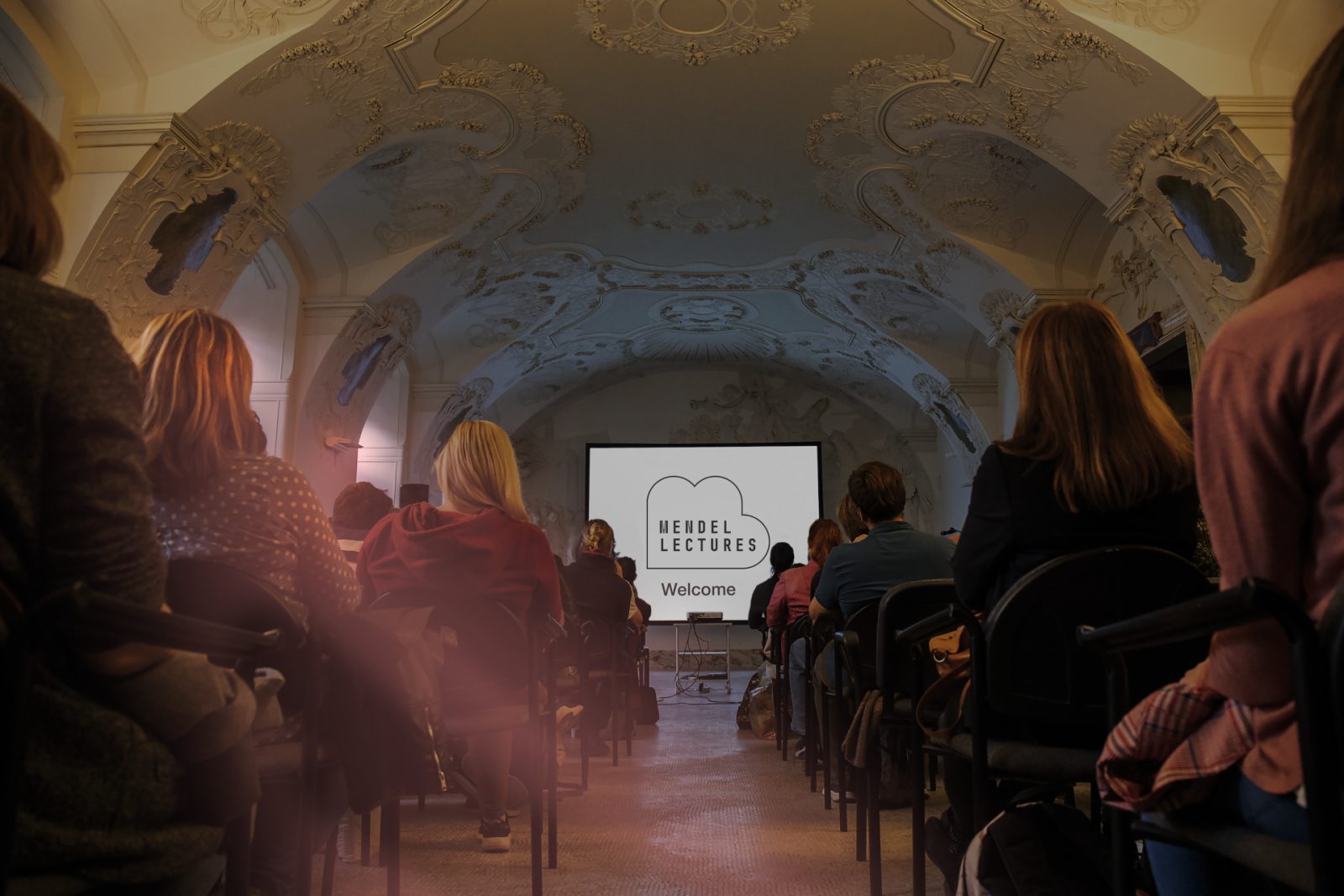
The venue for the new lecture series was no coincidence. Mendel Lectures take place at the Augustinian Abbey in Old Brno, where Gregor Johann Mendel carried out his famous experiments with peas between 1856 and 1863. For many international guests, the opportunity to speak here has a special significance: they are standing on the very ground where Mendel conducted the experiments that laid the foundations of genetics. “For me as a speaker, it always brings a tear to my eyes – talking about genomics and gene-editing in the birthplace of genetics and wishing Gregor Mendel could hear what his discoveries produced!” says Thomas Cech, Nobel laureate in Chemistry.
At a time when lectures by leading international scientists were far from commonplace in the Czech Republic, Mendel Lectures were an ambitious undertaking. The aim was not to stage a one-off prestigious event, but to create a long-term initiative that would regularly bring to Brno people whose work influences science worldwide. “When we started with Mendel Lectures, our main motivation was to reconnect Gregor Johann Mendel, Brno and world-class science. We were never short of excellent speakers – Mendel’s name opened doors, and over time the quality of the programme and previous guests became the best recommendation for those who followed. A much greater challenge was securing the resources that would allow us to organise the project at the appropriate level over the long term. Gradually, however, we succeeded in establishing a tradition that today brings some of the most important figures in world science to Brno while helping to keep Mendel’s legacy alive,” says Lumír Krejčí of the Faculty of Medicine at Masaryk University, who played a major role in organising and developing Mendel Lectures between 2006 and 2023.
In the 2026/2027 academic year, Mendel Lectures enter their 25th season. Across the previous 24 seasons, 154 lectures have taken place and more than 20 Nobel laureates have come to Brno. One further fact is particularly striking: nine speakers received the Nobel Prize only after appearing at Mendel Lectures. They include Emmanuelle Charpentier, who came to Brno for Mendel Lectures in March 2019 and received the Nobel Prize in Chemistry the following year for the development of a method for genome editing using CRISPR-Cas9.
The fact that future Nobel laureates have repeatedly appeared among Mendel Lectures guests before receiving the award in Stockholm is a strong indication of the consistently high standard of speaker selection.
Not everyone gets an invitation to Brno
The Mendel Lectures programme is not put together just a few months before the start of a semester. The diaries of leading scientists fill up far in advance, so the organisers often begin arranging individual visits several years ahead.
Who appears on the programme is not a matter of chance or the personal contacts of individual organisers. Since 2015, the selection has involved the international Mendel Lectures Scientific Advisory Board, whose members include scientists from institutions such as Harvard University, Rockefeller University and the Max Planck Institute. Four of the six current board members also have personal experience of Mendel Lectures as speakers. One of them is Aaron Ciechanover, Nobel laureate in Chemistry, who gave a lecture in Brno in October 2015. Ciechanover sees the significance of the series as extending beyond the communication of scientific knowledge itself: “The Mendel Lectures do not only make the most up-to-date science accessible to the general public, but they provoke people to think and discuss the complicated ethical and geopolitical implications that come with it – let it be genetic manipulation or climate change, for example.”
The history of Mendel Lectures itself also plays an important role when speakers are approached. Scientists often want to know who has spoken in Brno before them. It is precisely this continuity and the quality of the programme that create a level of trust that cannot be built in just a few years.
When the lecture does not end with the last slide
Mendel Lectures are exceptional not only because of the names on the programme. Another important part of their value lies in the personal encounters they make possible – encounters that would otherwise be impossible or difficult to access for most students and early-career scientists. Speakers usually spend an additional one or two days in Brno, taking part in informal discussions with research group leaders and students. It is in these moments that Mendel Lectures become more than a lecture series: a place where new ideas, collaborations and professional relationships can emerge.
According to Thomas Cech, the interest shown by students is one of the things that sets Mendel Lectures apart from other scientific lecture series: “The busloads of students coming to hear the Lecture makes the experience exceptional. And they ask such sophisticated questions!”
From the outset, the organisers have also made sure that the lectures remain open. The audience regularly brings together secondary-school pupils, university students, PhD candidates, research group leaders and senior scientists. They are joined by people from companies and members of the public with an interest in science. This openness is one of the reasons Mendel Lectures occupy such a distinctive position. They are not a closed event for a narrow group of specialists, but a place where people from different parts of the scientific and innovation community can meet naturally.
The reach of the lectures also extends beyond the audience in the room. The talks are streamed live and video recordings remain available online. Eleven Mendel Lectures guests – including Emmanuelle Charpentier, Ada Yonath and Stefan Hell – have also been interviewed for Czech Television’s Hyde Park Civilisation (Hyde Park Civilizace) during their visits.
When world-class science benefits the whole region
The significance of Mendel Lectures can be viewed from several perspectives. For a student, they may offer a first personal encounter with a scientist whose work has transformed an entire field. For a PhD candidate, they may provide the impetus for a research stay abroad or help shape the choice of a laboratory for postdoctoral research. For a research group leader, they offer an opportunity to establish new international contacts or receive feedback on their research.
For Brno and the South Moravian Region as a whole, Mendel Lectures are also evidence that the region can attract leading figures in world science and create opportunities for them to engage with the local scientific community. Connections of this kind are an important part of an environment in which high-quality research can thrive and new collaborations can emerge. For a quarter of a century, Mendel Lectures have contributed to this environment by regularly bringing to Brno scientists whom local students and researchers might otherwise encounter only through their publications.
A tradition worth continuing
Mendel Lectures are the result of sustained work by several generations of organisers, scientists and institutions who believed that bringing world-class science to Brno mattered. Today, their significance extends far beyond the boundaries of a single university or research centre.
Over the course of their history, Mendel Lectures have been funded from a range of Czech and international sources. At different times, the series has received support from the South Moravian Region, the City of Brno, the Czech Academy of Sciences, the British Council, the Ammerer Charity in Vienna, Austria’s Research Institute of Molecular Pathology, and the Czech Ministry of Education, Youth and Sports together with the European Union. Today, the series relies primarily on support from Masaryk University and FNUSA-ICRC. Yet in its 24 seasons, Mendel Lectures have never had a corporate partner.
This is why the organisers are now looking for new partners from companies, financial institutions and the public sector. Not to fund a single lecture, but to help sustain a tradition that has connected Czech science with the world for more than two decades, inspired young people and strengthened the position of Brno and the South Moravian Region as a region of science and innovation. “Over a quarter of a century, Mendel Lectures have reached a standard that we want to preserve for the next generation of students and scientists. But the costs of running an international series are rising, while the budget has not increased since 2020. We therefore want to return to a broader model of support and open Mendel Lectures to new partners who see value in supporting science and education over the long term,” says Kamil Paruch.
Mendel Lectures are therefore opening the next chapter of their history to new partners. By associating their name with a long-standing tradition of bringing the Czech scientific community together with world-leading researchers, partners can help sustain and further develop something that has been built in Brno over a quarter of a century – an open space for people and ideas to meet across institutional, national and generational boundaries.
Contact
Dalibor Blažek, PhD, CEITEC Masaryk University: dalibor.blazek@ceitec.muni.cz
Assoc. Prof. Kamil Paruch, PhD, Faculty of Science, Masaryk University: paruch@chemi.muni.cz
Photogallery
Author
