 Share
Share
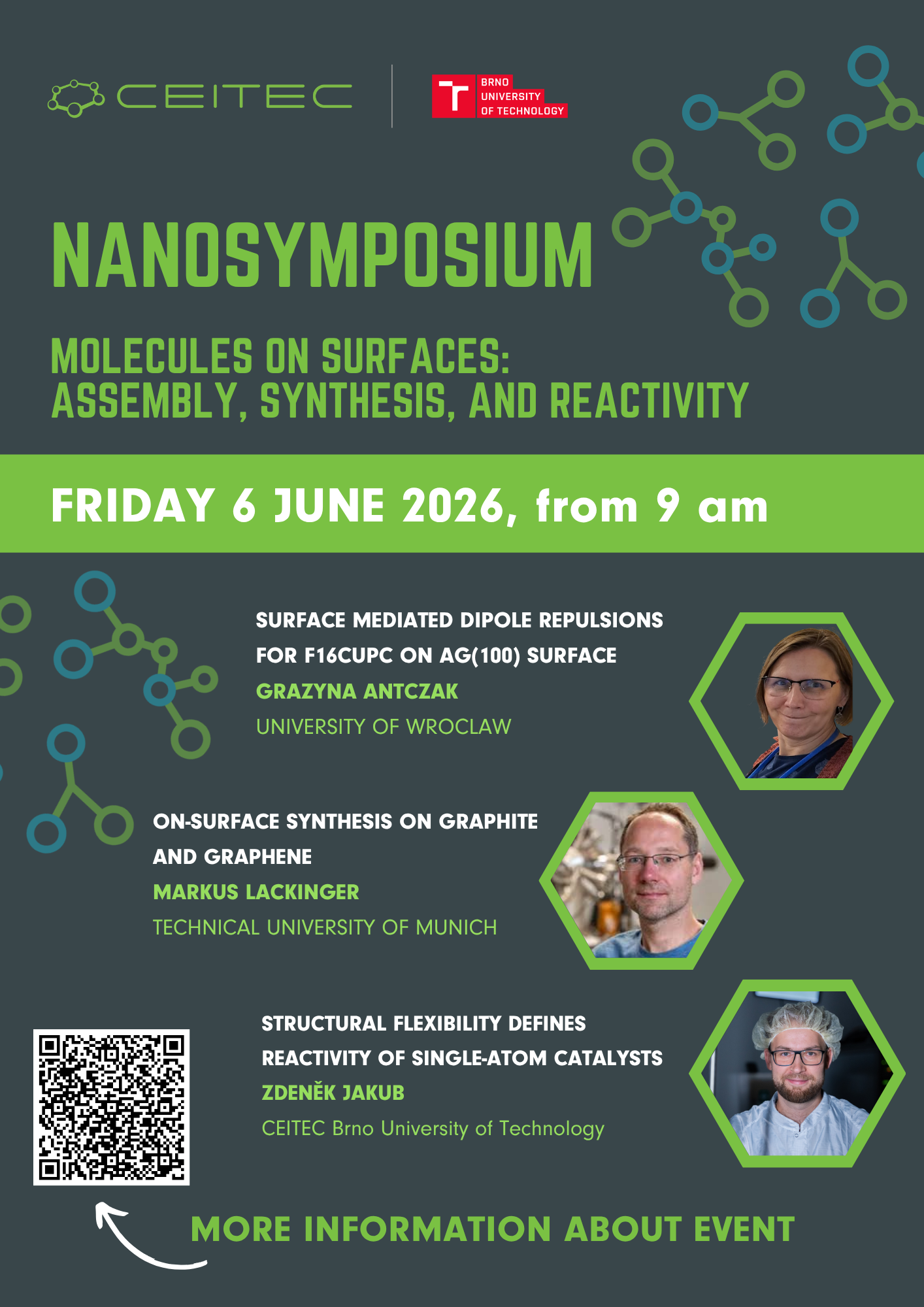
About Event
We will discuss recent advances in molecular surface science, with emphasis on self-assembly and on-surface synthesis on metals and graphene, as well as on the properties of the resulting nanostructures. Particular attention will be devoted to intermolecular interactions in phthalocyanine assemblies, strategies for achieving on-surface synthesis on weakly interacting substrates, and structure–reactivity relationships in single-atom catalysts. The program integrates experimental and theoretical approaches, including STM, LEED, and DFT calculations, and provides an overview of current developments in nanoscale materials science and catalysis.
Programme
Grażyna Antczak
University of Wrocław
Surface Mediated Dipole Repulsions for F16CuPc on Ag(100) surface
In my talk, I plan to present data on the growth dynamics of fluorinated copper phthalocyanine (F16CuPc) on Ag(100) surfaces, focusing on the transition from a two-dimensional (2D) molecular gas phase to a condensed 2D phase. Our data reveal that repulsive intermolecular interactions are responsible for condensation into an ordered structure. Low-energy electron diffraction (LEED) and scanning tunnelling microscopy (STM) was used to gain insights into the structural evolution, while density functional theory (DFT) calculations help us determine the underlying molecular interactions.
Markus Lackinger
Deutsches Museum und Technische Universität München
On-Surface Synthesis on Graphite and Graphene
On-Surface Synthesis, i.e. the covalent coupling of functionalized molecules on solid surfaces, provides access to extended, low-dimensional organic nanostructures that remain elusive to wet chemistry. Therefore, metal surfaces are the primary choice because their tunable reactivity facilitates various coupling reactions. But the strong adsorption on metal surfaces is a major drawback, as this distorts the molecular material's intrinsic electronic and structural properties. Accordingly, inert supports are essential for harnessing the full potential of on-surface synthesized nanostructures. This important goal can be achieved in two principal ways, either conventional synthesis on metal surfaces followed by subsequent transfer, or direct synthesis on inert surfaces.1 The latter method not only eliminates a laborious processing step, but also prevents degradation of the nanostructures during transfer. In addition, direct synthesis on inert supports may offer benefits for structure quality.
We have chosen graphitic surfaces not only because of their compatibility with Scanning Tunneling Microscopy, but also because they are fully inert under ambient conditions. Furthermore, a direct comparison of graphite and graphene sheds light on still present substrate effects.
Two approaches to on-surface synthesis on graphitic surfaces are discussed: (1) Thermal coupling, where the heating step is carried out in an inert gas atmosphere to prevent premature desorption of the reactants;2 and (2) photochemical coupling.3 Two different implementations are presented here: (a) the light-induced formation of intermolecular cyclobutane linkages via thermally forbidden [4+4] cycloadditions,4 and (b) the photodissociation of iodine-substituents resulting in covalent carbon-carbon bonds formed by subsequent radical addition. Conversely, a defined supramolecular self-assembly is essential for the former approach, but mostly detrimental for the latter.
(1) Dalton Trans. 50, 10020-10027 (2021).
(2) Angew. Chem. Int. Ed. 64, e202422521 (2025).
(3) Trends Chem. 4, 471-474 (2022).
(4) Nat. Chem. 13, 730–736 (2021)
Zdeněk Jakub, CEITEC
Brno University of Technology
Structural flexibility dictates reactivity of single-atom catalysts
“Single-atom” catalysis (SAC) presents a recent frontier in catalysis research, promising to lower our dependence on precious metals and improve the economic viability of carbon-neutral technologies. Countless SACs were reported over the past decade, but rational design remains a challenge because the reactivity of “single atoms” is not easy to predict. The main hurdle is that the reactivity doesn’t depend only on the metal atom used, but crucially also on the atomic-scale structure of its local environment.[1–3] This renders many reactivity trends developed on nanoparticle catalysts inapplicable for SACs, and requires us to establish new descriptors that could guide efficient SAC research.
In my talk, I will show how we address this challenge from a surface science perspective. We synthesize model “single-atom” sites (with metal-Nx coordination) by embedding them within on-surface prepared 2D metal-organic frameworks.[4] Placing these models atop chemically inert supports allows us to disentangle the effects of local coordination geometry from the effects of electronic structure variations. Our work reveals large reactivity differences between “single-atom” sites that are electronically identical.[5–7] Specifically, the adsorption energy of probe molecules atop high-spin Fe2+ cations vary by up to ≈1 eV, depending on the coordination geometry (Fe-N3 vs. Fe-N4) and the underlying support material (gold vs. graphene). These large reactivity differences originate from distinct possibilities of structural relaxations, which cannot be predicted by standard reactivity descriptors based on electronic structure analysis. Overall, these systematic atomically-resolved studies unravel the fundamental aspects defining SAC reactivity, which is a critical prerequisite to rational SAC design.
[1] Z. Jakub, J. Hulva, M. Meier, R. Bliem, F. Kraushofer, M. Setvin, M. Schmid, U. Diebold, C. Franchini, G. S. Parkinson, “Local Structure and Coordination Define Adsorption in a Model Ir1/Fe3O4 Single-Atom Catalyst” Angew. Chem. Int. Ed. 2019, 58, 13961–13968.
[2] Z. Jakub, J. Hulva, P. T. P. Ryan, D. A. Duncan, D. J. Payne, R. Bliem, M. Ulreich, P. Hofegger, F. Kraushofer, M. Meier, M. Schmid, U. Diebold, G. S. Parkinson, “Adsorbate-induced structural evolution changes the mechanism of CO oxidation on a Rh/Fe3O4(001) model catalyst” Nanoscale 2020, 12, 5866–5875.
[3] J. Hulva, M. Meier, R. Bliem, Z. Jakub, F. Kraushofer, M. Schmid, U. Diebold, C. Franchini, G. S. Parkinson, “Unraveling CO adsorption on model single-atom catalysts” Science. 2021, 371, 375–379.
[4] Z. Jakub, A. Kurowská, O. Herich, L. Černá, L. Kormoš, A. Shahsavar, P. Procházka, J. Čechal, “Remarkably stable metal–organic frameworks on an inert substrate: M-TCNQ on graphene (M = Ni, Fe, Mn)” Nanoscale 2022, 14, 9507–9515.
[5] J. Planer, D. Hrůza, T. Lesovský, A. Jabeen, J. Čechal, Z. Jakub, “Structural flexibility dictates reactivity of single-atom catalysts” arXiv preprint 2603.12424 2026.
[6] Z. Jakub, J. Planer, D. Hrůza, A. Shahsavar, J. Pavelec, J. Čechal, “Identical Fe–N4 Sites with Different Reactivity: Elucidating the Effect of Support Curvature” ACS Appl. Mater. Interfaces 2025, 17, 10136–10144.
[7] Z. Jakub, A. Shahsavar, J. Planer, D. Hrůza, O. Herich, P. Procházka, J. Čechal, “How the Support Defines Properties of 2D Metal–Organic Frameworks: Fe-TCNQ on Graphene versus Au(111)” J. Am. Chem. Soc. 2024, 146, 3471–3482.