

 Share
Share
5. Aug. 2026
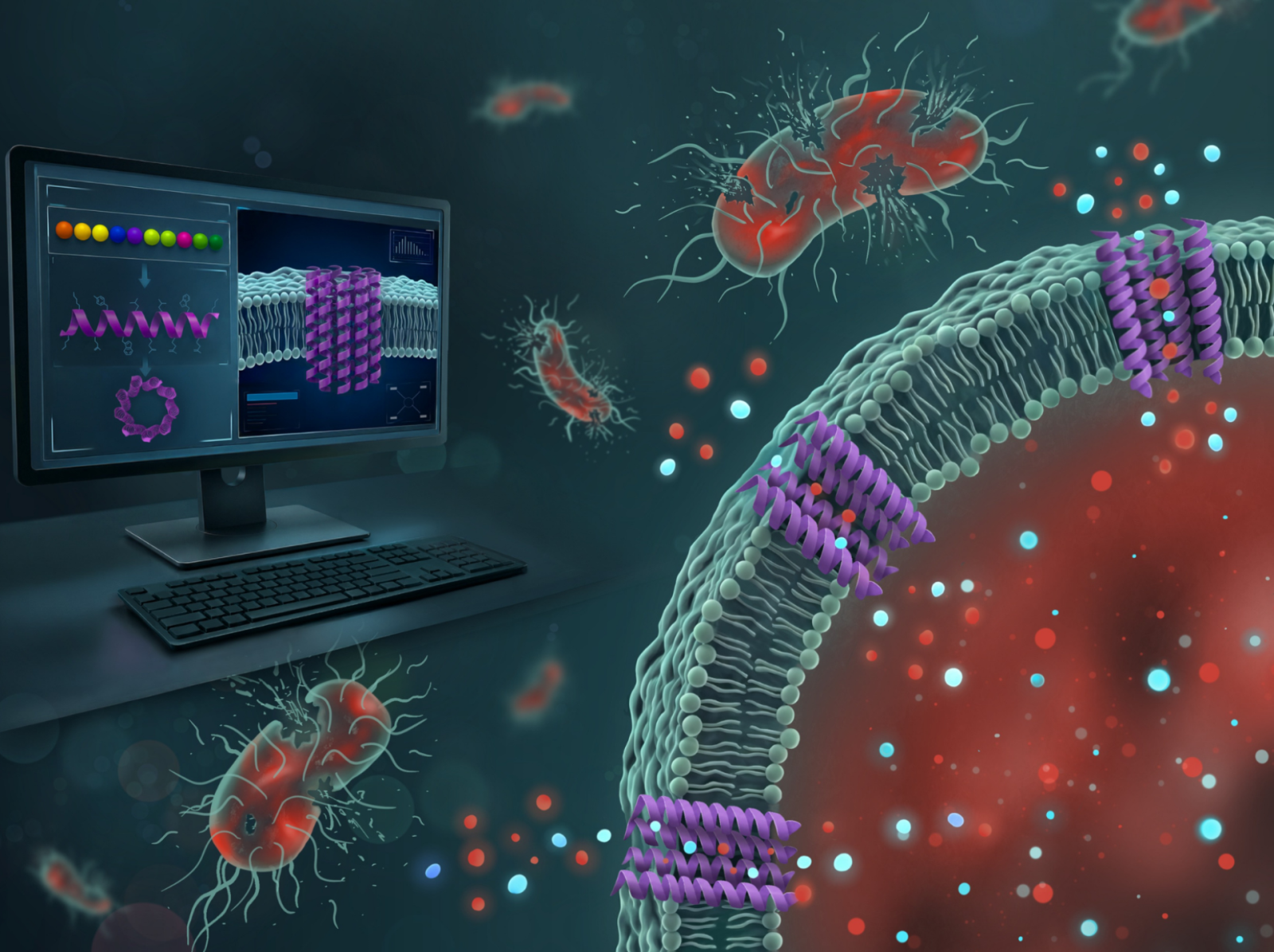
An international team led by researchers from CEITEC Masaryk University has developed a computational method for designing entirely new antimicrobial peptides – short proteins capable of killing bacteria. Instead of relying on the lengthy process of searching for suitable molecules in nature, the researchers can now use molecular simulations to predict their properties and design new molecules with specific functions. The resulting peptides successfully eliminated bacteria resistant to conventional antibiotics and proved effective in preclinical mouse models. The findings introduce a new approach to developing future antibiotics as well as other biologically active peptides.
According to the World Health Organization, antibiotic resistance is one of the greatest global health threats of our time. Every year, the number of bacteria resistant to available antibiotics continues to grow. At the same time, developing new drugs is a lengthy and costly process in which most candidate molecules ultimately fail.
Researchers at CEITEC Masaryk University have therefore taken a different approach. Rather than searching randomly for antimicrobial compounds, they developed a method for designing them based on molecular design principles. Using molecular simulations, they analysed around 150 peptides in detail and identified the rules that govern the design of molecules capable of forming stable pores in bacterial membranes. These tiny openings disrupt the membrane barrier, causing bacteria to lose control of their internal environment and ultimately die. "We discovered how to arrange specific amino acids so that the resulting peptides form pores in bacterial membranes. This now allows us to generate an enormous number of peptide candidates and select those with the properties we are looking for," says Robert Vácha from CEITEC Masaryk University, who led the research.
The researchers validated the most promising peptide designs experimentally. They confirmed their activity against a group of the most dangerous antibiotic-resistant bacteria. The best results were achieved against Acinetobacter baumannii, which the World Health Organization classifies as a priority drug-resistant pathogen. The team also demonstrated that their most successful peptide does not damage human red blood cells and shows no significant toxicity towards human cells. Its efficacy was further confirmed in two preclinical mouse models of bacterial infection.
The significance of the study lies not only in identifying a new antibiotic candidate but, more importantly, in establishing a new design strategy. Based on their findings, the researchers developed a set of design principles and 52 sequence templates that can be used to design approximately 10 trillion molecules, providing other research teams with a framework for developing new membrane-disrupting peptides. The same principle that proved successful against bacteria could also be applied in the future to develop anticancer therapeutics, biosensors, or targeted drug delivery systems.
"Until now, researchers have mostly searched for biologically active molecules created by nature and only then investigated how they work. We reversed this process. First, we studied which molecular properties are required for a particular mechanism of action – in our case, the ability to stabilize membrane pores – and then used this knowledge to design entirely new peptides that make such pores. This approach could significantly accelerate the development of new medicines and help us keep pace with the growing challenge of antibiotic resistance," adds Robert Vácha, who has received ERC grants for his research.
The study was carried out in collaboration with researchers from the University of Pennsylvania, the University of Groningen, Palacký University Olomouc, and the Institute of Microbiology of the Czech Academy of Sciences. The results were published in Nature Chemical Biology.
Photogallery
Author

Expert
