

 Share
Share
18. Feb. 2026
A new generation of magnetic materials, known as antiferromagnets and altermagnets, could replace silicon-based technologies in the future, enabling data recording speeds up to a thousand times faster with significantly lower energy consumption. These materials have unique properties that allow them to function even in extremely small structures and could thus be the answer to the demands of the modern age and the ever-increasing need for miniaturization of components. These fundamental challenges are being addressed by the TERAFIT project, in which CEITEC BUT is collaborating, with scientists led by Vojtěch Uhlíř working on the development of methods for imaging this new generation of materials.
In 2024, a four-year research project called TERAFIT was launched in the Czech Republic to develop a new generation of information technologies. The project focuses on advanced magnetic materials that could eventually replace current silicon chips. The TERAFIT project is funded by the Ministry of Education, Youth and Sports of the Czech Republic under the Jan Amos Komenský Operational Programme (JAK). The consortium of three institutions is led by Professor Tomáš Jungwirth from the Institute of Physics of the Czech Academy of Sciences. Other partners include experts from Charles University and research teams at CEITEC BUT.
Current IT technologies consume enormous amounts of energy and are reaching their physical limits. In addition to standard operations such as transportation, lighting, and building heating, further dramatic growth in digital technologies is expected. “Our goal is to develop a new concept of computing systems that will enable faster, more energy-efficient, and better scalable technologies for the era of artificial intelligence,” explains Vojtěch Uhlíř.
Materials of the Future: Antiferromagnets and Altermagnets
Today’s IT technologies are based on ferromagnetic materials. When exposed to an external magnetic field, these materials become strongly magnetized and can retain this magnetization even after the field is removed. Inside these materials, atoms behave like tiny “magnets” that are mostly aligned in the same direction, causing the entire material to act as a strong magnet.
However, these materials are reaching their limits; when efforts are made to miniaturize components and accelerate data writing, their properties begin to deteriorate.
In contrast, antiferromagnets and the newly discovered altermagnets – whose introduction into global research has been significantly driven by scientists from the Institute of Physics of the Czech Academy of Sciences – offer new possibilities thanks to their unique properties and their ability to function even in extremely small structures.
In antiferromagnets, the internal “magnets” are arranged alternately: one atom is oriented in one direction, while the neighbouring atom is oriented in the opposite direction. These magnetic effects cancel each other out, making the material appear almost non-magnetic externally. Moreover, this arrangement responds only weakly to external magnetic fields, making antiferromagnets excellent candidates for new types of very small, fast components.
Altermagnets may be even more promising. They are exceptional because they combine properties of both previous types: externally, they are not strongly magnetic like conventional magnets, yet they can influence electrons in components in ways that are useful for storing and processing information. Thanks to this unique combination, they may enable new types of memory and chips that are faster, more energy-efficient, and better suited for future technologies, such as artificial intelligence.
Cutting-Edge Infrastructure at CEITEC BUT
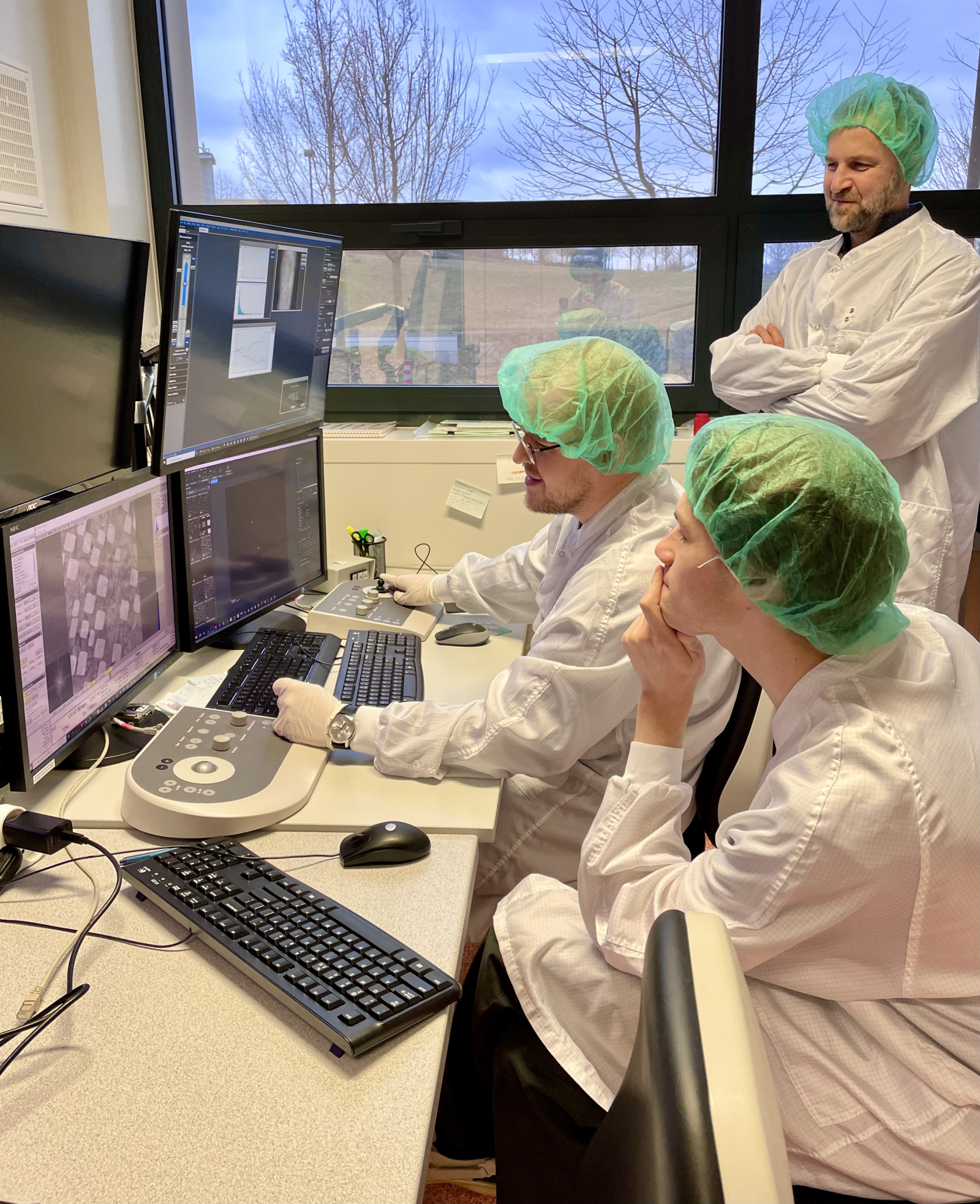
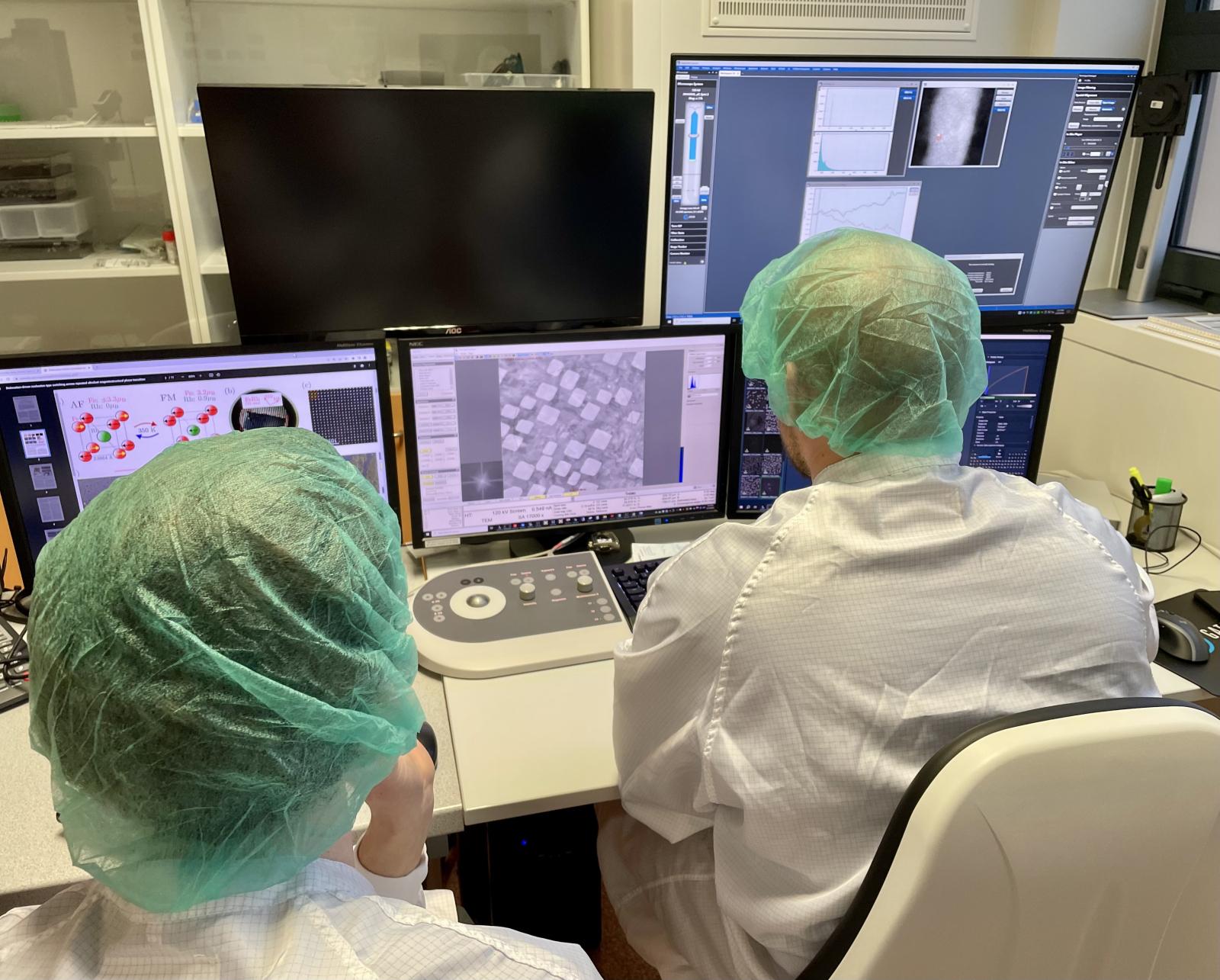
Teams at CEITEC BUT are developing imaging and analytical methods that enable the study of magnetic materials down to the level of individual atoms. A key role in the project is played by the TITAN transmission electron microscope, which has recently undergone a significant upgrade.
Thanks to a new lens corrector and a state-of-the-art spectrometer, scientists can now observe material structures with extraordinary resolution and speed. The new spectrometer, in particular, was funded through the TERAFIT project. “Spectroscopy enables us to create detailed chemical maps of the samples under study. Using these approaches, we can, for example, compare the different magnetic behaviours of various elements within the same material,” explains Uhlíř.
The TITAN microscope is part of the CEITEC Nano research infrastructure and the larger CzechNanoLab research infrastructure, coordinated by Michal Urbánek from CEITEC BUT. “Thanks to its integration into the large CzechNanoLab research infrastructure, this cutting-edge microscope is accessible not only to scientists from CEITEC but also to researchers from other institutions in the Czech Republic and abroad,” Urbánek concludes.
Authors: Kristina Blűmelová a Petra Králová
Photogallery
Expert
