

 Share
5. Nov. 2026
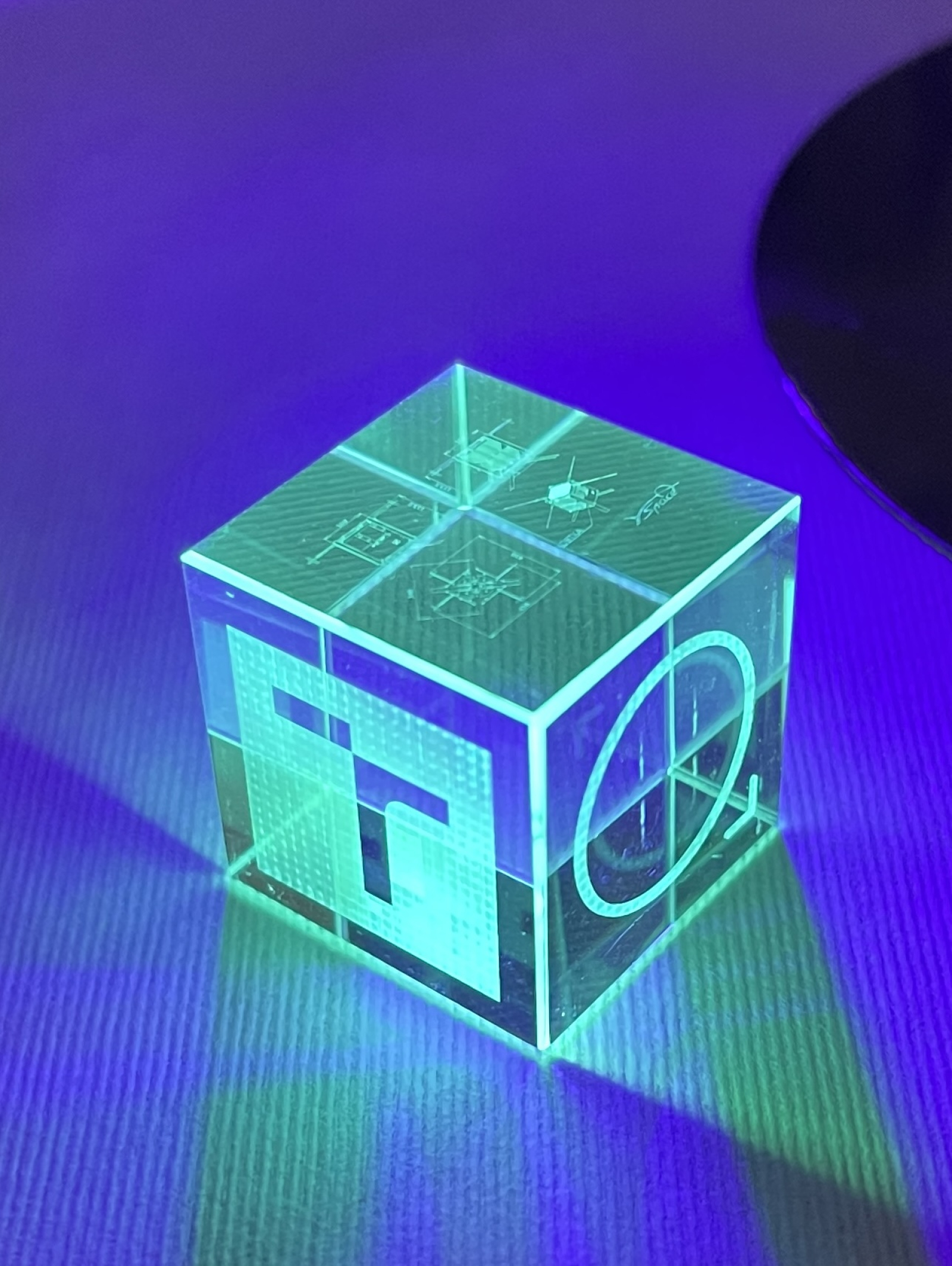
A glass cube with two-centimeter-long edges is set to accompany Czech astronaut Aleš Svoboda to the International Space Station (ISS). On its surface, specialists from the CEITEC Nano laboratories at CEITEC Brno University of Technology (BUT) used two-photon 3D printing to create a logo and a scaled-down technical drawing of the KOSTKA satellite. The satellite was designed and built by YSpace, a student space and satellite team based at the Faculty of Electrical Engineering and Communication Technologies (FEEC) at BUT. The “Space in a Cube” project thus connects the technological infrastructure of CEITEC BUT with the work of students at the same university and aims to bring science and technology closer to schools and the public.
The cube, made of Czech crystal and measuring 2 × 2 × 2 centimeters with a weight of approximately twenty grams, is intended to serve as an educational tool for schools, observatories, planetariums, and science centers. Its simple shape offers a starting point for explaining a range of physical phenomena—from the properties of light to the origin of the elements that make up glass, to the behavior of objects in zero gravity.
The project was inspired by an effort to use Aleš Svoboda’s upcoming mission to foster young people’s interest in science and technical fields. “It resembles a sugar cube, a Czech invention known throughout the world. At the same time, it references the student satellite KOSTKA, which was designed, built, and is currently operated by students from the YSpace team at the Faculty of Electrical Engineering and Computer Science (FEEC) at Brno University of Technology,” explains Jakub Rybář from the Ministry of Education, Youth, and Sports of the Czech Republic. In addition to the Ministry, Jiří Dušek from the Brno Observatory and Planetarium and specialists from CEITEC Nano contributed to the project’s implementation.
Micrometer-scale structures created by light
The technological aspects of the project were handled by the CEITEC Nano laboratories at CEITEC BUT. Before printing, the surface of the glass cube had to be thoroughly cleaned with a mixture of sulfuric acid and hydrogen peroxide, followed by treatment with an oxygen plasma. The team then used a two-photon polymerization 3D printer, which allows for the creation of structures with a resolution of less than one micrometer—that is, one-millionth of a meter.
The logos consist of lines approximately one micrometer wide. “These fine structures cause light diffraction: light bends around them and breaks down into a colour spectrum. The colour effect is thus created by the surface structure itself,” explains Ondřej Červinka from CEITEC BUT, who was in charge of preparing the structures on the cube’s surface. The technical drawing of the satellite is created using lines approximately five micrometers wide and high, making it possible to observe it directly under an optical microscope.
From a Student Satellite to a Microscopic Drawing
While CEITEC BUT contributed expertise and instrumentation for creating the microscopic structures, the YSpace team brings the story of a real student space mission to the project. Their satellite, KOSTKA, was launched into Earth’s orbit on July 7, 2026. Students from the Faculty of Electrical Engineering and Computer Science (FEEC) at Brno University of Technology designed, assembled, and tested it, and are now responsible for its operation.
If everything goes according to plan, the educational cube will travel to the ISS with Aleš Svoboda. Its story and educational content are presented on the website Space in a Cube, which was developed by the Brno Observatory and Planetarium in collaboration with BUT and the Ministry of Education, Youth and Sports. The project will connect the natural sciences, technology, engineering, the arts, and mathematics, and offer an opportunity to demonstrate just how many scientific questions even a small piece of glass can raise.
Photogallery
Expert
