

 Share
Share
21. Jan. 2026
A team from CEITEC Masaryk University (MUNI) has described a new mechanism by which cells control RNA processing during the handling of genetic information. The discovery shows how the cooperation of two enzymes ensures the accuracy of this process and explains why its failure can lead to impaired cellular function. The findings are also relevant for research into diseases in which the processing of genetic instructions is disrupted.
To produce functional proteins, cells require instructions stored in genes. These instructions can be compared to a long text that contains many unnecessary words and therefore cannot be read properly. Cells therefore proceed in two steps. First, the enzyme CDK7 initiates the transcription of the entire gene into an RNA molecule. This is followed by the removal of meaningless parts of the text. The result is a readable set of instructions for protein production.
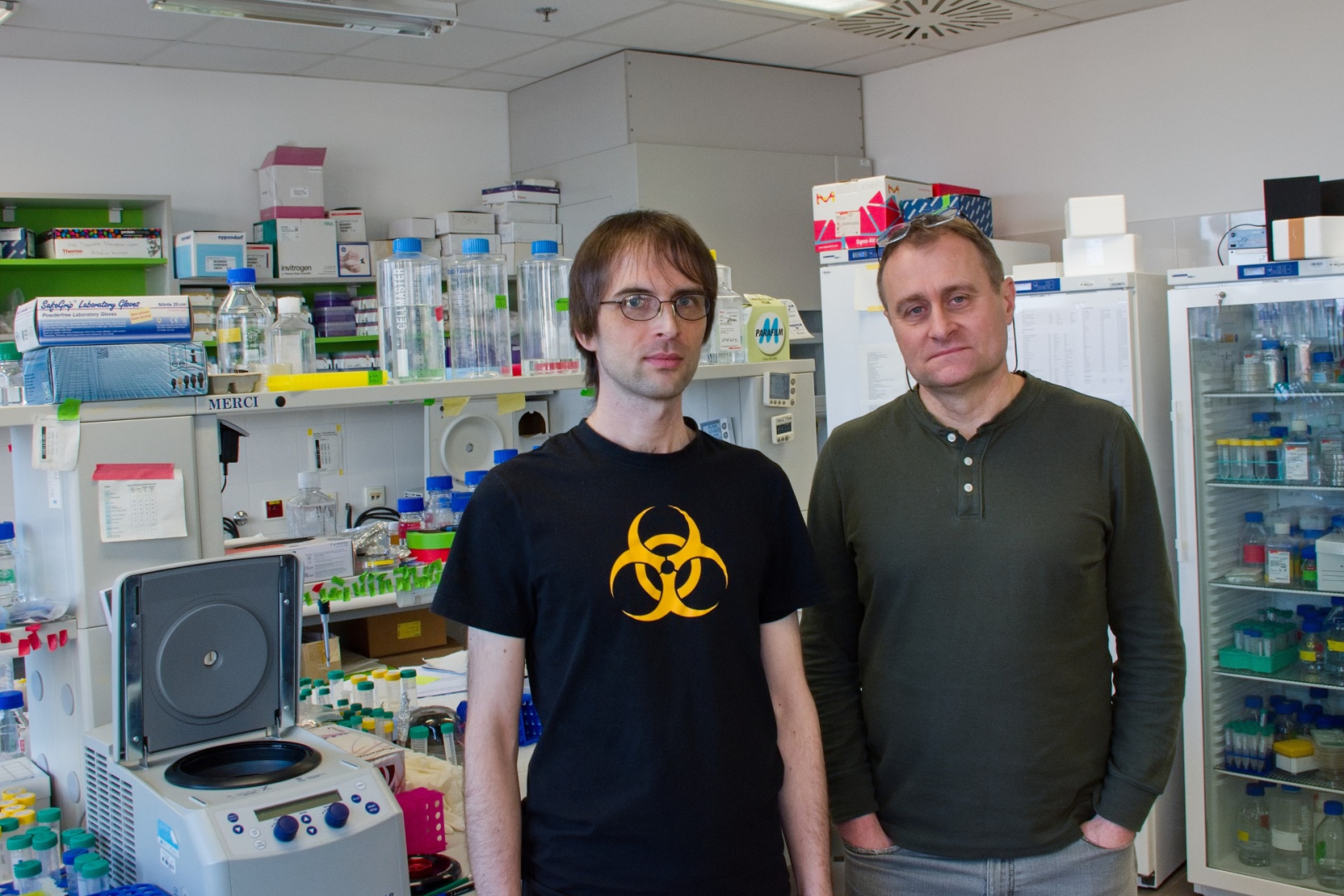
Researchers led by Dalibor Blažek at CEITEC MUNI had previously shown that RNA splicing is controlled by the enzyme CDK11. They have now clarified how these two steps are connected within the cell. They found that, at the right moment, the enzyme CDK7 activates CDK11, ensuring that the entire process of transcription followed by splicing proceeds correctly. If either of the studied enzymes does not function properly, the resulting instructions become unreadable and non-functional proteins are produced.
“Previously, it was thought that the removal of unnecessary RNA segments was controlled solely by the enzyme CDK7. Our results show, however, that the key role is played by CDK11, and that only its activation leads to the formation of an RNA molecule with readable instructions for protein production,” says first author of the study, Michal Rájecký.
The newly described mechanism is also important from a medical perspective. In many cancers, the process of RNA splicing is frequently altered, leading to the production of faulty genetic instructions. Cancer cells produce large amounts of RNA and are highly dependent on its correct processing. If the enzymatic control of this process fails, cells cease to function properly and the risk of pathological changes increases. The enzymes CDK7 and CDK11 play a key role in this control, which is why, alongside research on CDK7, scientific interest in CDK11 has grown in recent years.
“Cancer cells are particularly sensitive to errors in RNA processing, because their ability to function and proliferate directly depends on it. Our study shows that the enzymes CDK7 and CDK11 form an important regulatory hub in this process,” adds corresponding author Dalibor Blažek, who has long led this line of research.
Overall, the study contributes to a deeper understanding of how transcription of genetic information and its subsequent processing are interconnected within the cell. At the same time, it provides a framework for further research focusing on how these mechanisms operate in cancer cells and whether they can be targeted in the future.
The results of the research were published in Nucleic Acids Research.
Photogallery
Author

Expert
