 Share
23. Nov. 2026
He is one of the authors of a method for measuring the properties of short spin waves, which was published last year in the prestigious journal Science Advances. He is now also the recipient of the Minister of Education’s Award for outstanding students and graduates, for which he was nominated by the Faculty of Mechanical Engineering at Brno University of Technology (BUT). Jakub Krčma has thus achieved another significant success in a short space of time. As a member of the CEITEC Nano research team and a student at CEITEC BUT, he is now continuing his research and preparing the groundwork to enable his method to be used in the design of smaller and more efficient chips.
How did you feel when you found out you were to receive the Minister of Education’s Award for Outstanding Students and Graduates?
I was really pleased. It’s great feedback and external validation of my efforts over the whole five years at university. Although they say one should be cautious about relying on external validation, it’s still a brilliant feeling.
Did you have any inkling that you might receive the award?
I knew the possibility existed. In Michal Urbánek’s team at CEITEC BUT, of which I am also a member, three people have already won the award in previous years. On the other hand, I told myself it probably wouldn’t happen again.
I imagine that the research in which you developed a new method for measuring the properties of short spin waves also played a significant part in you winning the award. Can you explain what this involves?
Spin waves (magnons) are waves in the magnetic order of magnetic materials and can be used, for example, to transmit information. This can be utilised in computing technologies. Today, electrons flow through electrical circuits, but they generate heat, which leads to energy losses. By contrast, the use of spin waves can be much more energy-efficient.
And what did your discovery involve?
Spin waves can be studied, for example, using optical methods, one of which is called Brillouin scattering. It works as follows: we have laser light at a single frequency and focus it onto a sample. There, it interacts with the spin waves and, in the process, slightly changes its frequency. We then ‘collect’ the light back and monitor these shifts in frequency. However, some spin waves have a wavelength significantly shorter than that of the light we are using, so they cannot normally be detected. That is why we created a silicon lattice on the material under study which, to put it simply, compresses the light. The spin wave then interacts with this compressed light. Thanks to this, we are able to measure spin waves with a much shorter wavelength than was previously optically possible.
How is the research progressing and what lies ahead?
In a broader sense, this research was already the subject of Ondřej Wojewoda’s PhD thesis. I built on this with my bachelor’s thesis, which then led to an article in Science Advances. Through all this, we have demonstrated that the method works. We used materials on which this was clearly evident. Subsequently, in my master’s thesis, we wanted to show that it works on materials and spin waves that are more suitable for practical applications, such as computations or signal processing. We succeeded in this. However, it presents further challenges, particularly with regard to the excitation of short spin waves, which is what I am currently focusing on.
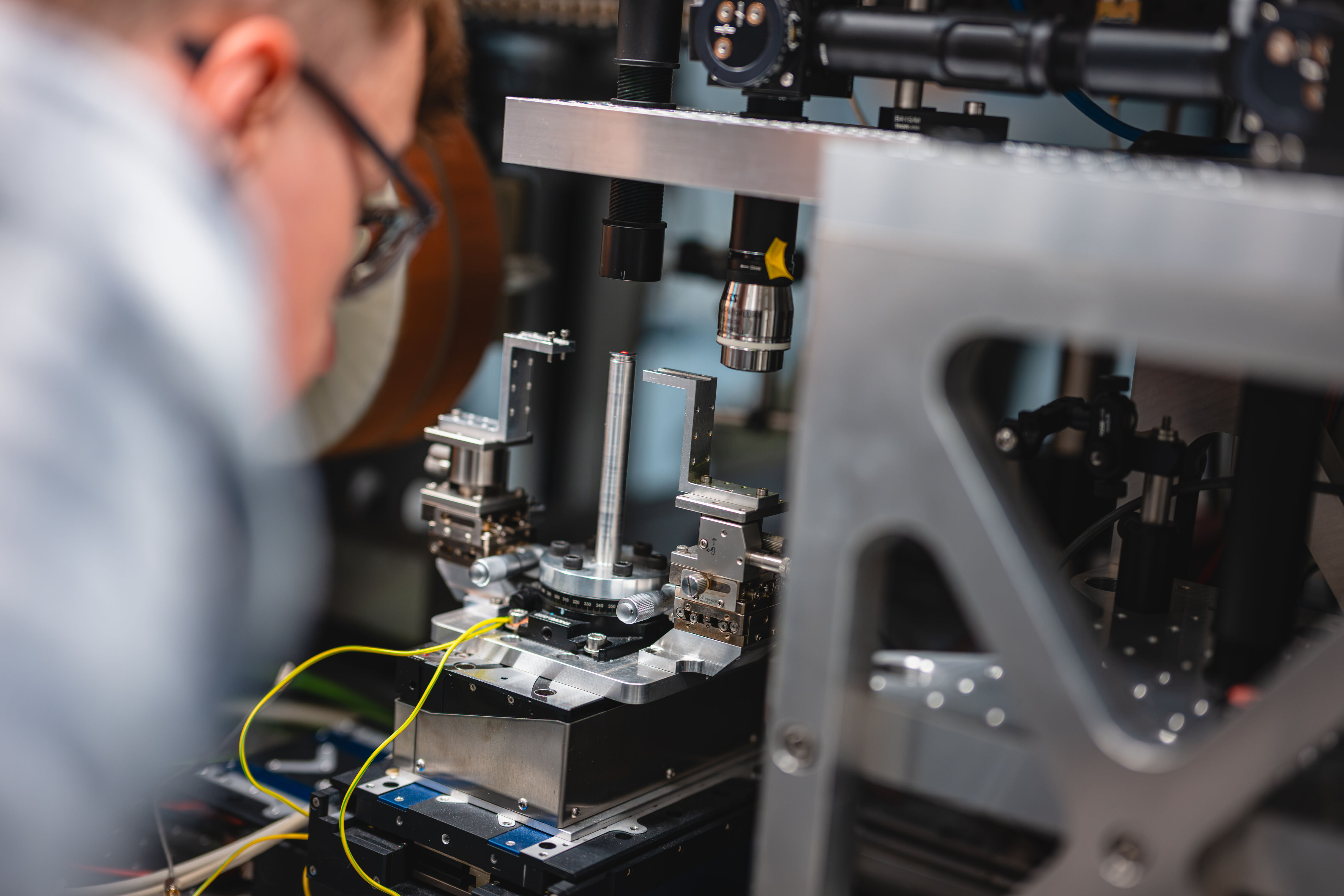
How do you balance this sort of research with your studies?
Fortunately, there is close collaboration between the Faculty of Mechanical Engineering at BUT, where I studied, and CEITEC BUT. From my first year onwards, we were able to undertake semester-long projects at both the faculty and CEITEC BUT. Thanks to an invitation from Ondřej Wojewoda, with whom I had laboratory practicals in my first year, I was then given the opportunity to join a group led by Michal Urbánek that specialises in magnonics – that is, the study of spin waves. We agreed on how much time I could devote to the research so that it could be balanced with my studies.
You were nominated for the Minister of Education’s Award for Outstanding Students and Graduates by the Faculty of Mechanical Engineering at BUT, where you studied engineering physics and nanotechnology. What drew you to this field?
At grammar school, I enjoyed physics and maths. So I was looking for a university where I could study some of those areas in a slightly more applied way. As I wanted to stay in Brno, BUT was the obvious choice. And the Faculty of Mechanical Engineering offered exactly the specialisation that appealed to me.
Why did you choose CEITEC BUT for your PhD?
I’d always associated research mainly with CEITEC BUT. The Faculty gave me the theoretical foundation on which everything is based, but I carried out the actual research predominantly at CEITEC BUT. When I was considering whether to continue at the Faculty or at CEITEC BUT, the fact that I already knew my supervisor, Michal Urbánek, was crucial for me. I knew how his group worked. And that I could seamlessly build on what I’d been doing so far. The tougher decision was whether to stay here or continue my studies abroad.
And what made you decide to stay in Brno?
The main factor was still the fact that I knew my supervisor. But it also helped that I had something to compare it with. As part of my Master’s programme, I spent half a year at the Paul Scherrer Institute (PSI) in Switzerland. And I realised that we’re very well catered for here and that there’s a lot of state-of-the-art technology. For example, I got to use an electron lithograph as early as the summer holidays after my first year. When I later had my interview at PSI, they were very surprised that I already had experience with it. Over there, they usually only let PhD students use it independently.
What do you see as the biggest advantage of studying at CEITEC BUT?
The main thing is probably the scale of the technical facilities, and the fact that students really do have access to them. Everything is in one place, so I can often design, fabricate and measure a sample without having to travel. And I can just pop down the corridor to see colleagues from other disciplines, such as nanophotonics. What’s more, everything is very well organised. If someone wants to use a piece of equipment, they make a booking and note down what they wanted to measure and what the results were. So they keep a sort of laboratory log. It’s centralised, which makes it easier to share results between groups.
Author: Jan Němec
Photogallery
Expert