

 Share
Share
9. June 2026
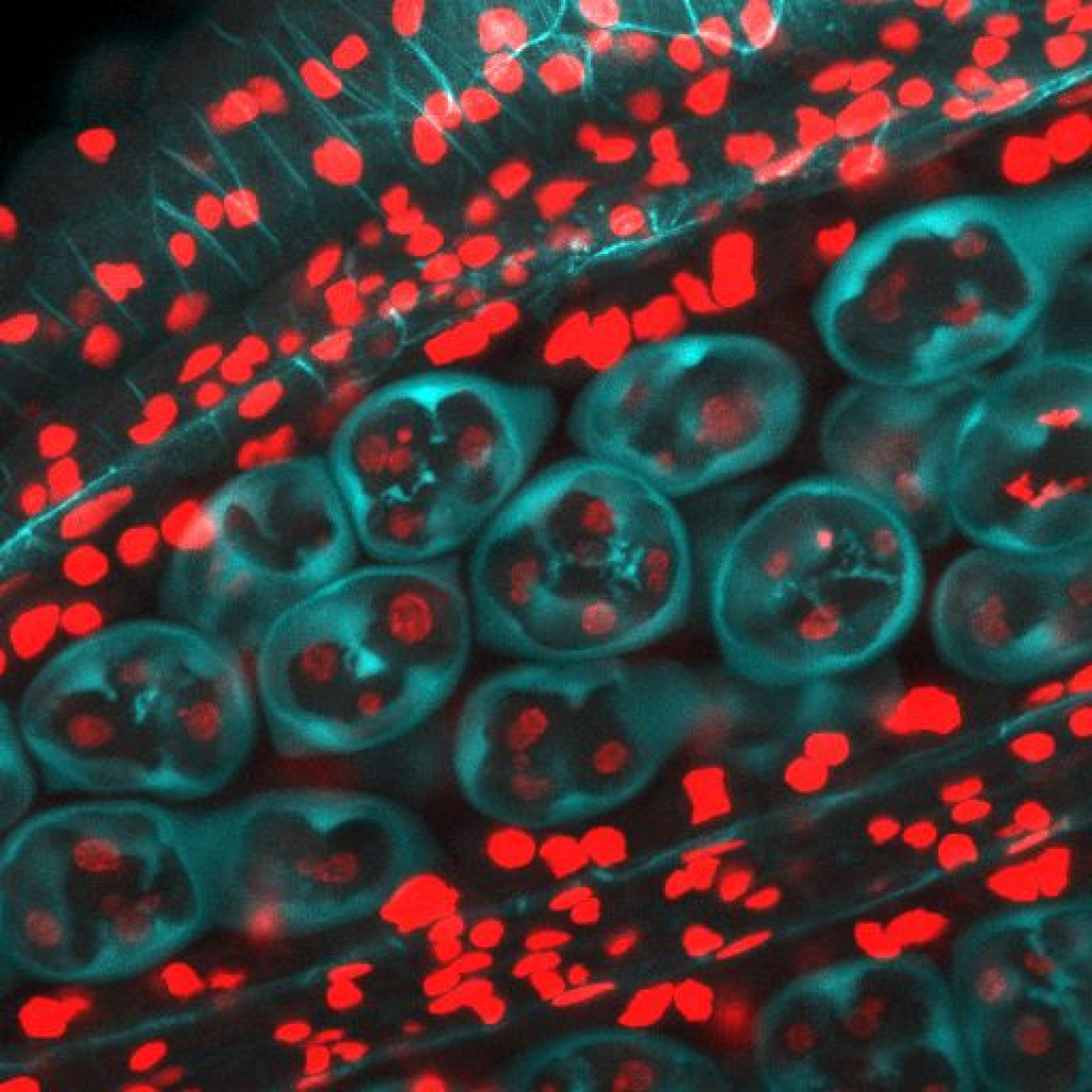
High temperatures pose a challenge for plants not only during growth but also during reproduction. Heat stress can disrupt the formation of germ cells and lead to errors in the transmission of genetic information to the next generation. In two complementary studies, scientists from CEITEC Masaryk University have described a previously unknown mechanism crucial for plant reproduction, with the capacity to sense and react to environmental challenges. At the heart of this mechanism are cellular structures known as meiotic bodies, or M-bodies.
To produce pollen and seeds, plants must undergo meiosis, a specialised type of cell division in which genetic information is distributed into reproductive cells. This is one of the most important processes in the plant life cycle, yet it is also highly sensitive to environmental changes. “High temperatures can significantly disrupt meiosis. We therefore wanted to first identify the directors of this process in plants, in order to understand how the transmission of genetic information is affected by stressful conditions” says Albert Cairo from Karel Říha’s research group at CEITEC Masaryk University (MUNI).
In the first study, the researchers described the discovery and function of meiotic bodies, structures that form in reproductive cells during meiosis. These bodies serve as temporary storage sites for mRNA molecules – the instructions used to produce proteins. They allow the cell to regulate which information is used immediately and which is retained for later stages of development. “We showed that the way proteins and mRNAs are organised inside meiotic cells is far more important than previously thought. mRNAs carry the instructions needed to produce proteins, and meiotic bodies act as organisational hubs that help store, sort and release these instructions at the right time during the formation of reproductive cells. We also described how these structures form, what components they contain, and how they are regulated by the cell,” explains Albert Cairo.
The second study, conducted in collaboration with Ghent University in Belgium, built on these findings. It showed that meiotic bodies are also important for the proper progression of meiosis under adverse conditions. The researchers found that under elevated temperatures, meiotic bodies are crucial for regulating mechanisms that ensure genetic information is correctly distributed among newly forming reproductive cells during meiosis. Plants in which this mechanism was impaired showed premature termination of meiosis and abnormal numbers of chromosomes in pollen grains. “Our findings show that meiotic bodies are more complex than expected, and they are configured with sensors that detect stressful conditions, acting as protecting walls. They contribute to ensuring that reproduction proceeds correctly even at higher temperatures” says Karel Říha, head of the research group.
Together, the two studies provide new insight into how plants coordinate one of their most important biological processes. They also expand our understanding of the mechanisms that may influence plant reproductive success in environments experiencing increasingly frequent temperature fluctuations.
International collaboration also played an important role in the research. Cédric Schindfessel, a PhD student from Ghent University spent two months at CEITEC MUNI through a fellowship from the European Molecular Biology Organization (EMBO). He came to Brno to take advantage of advanced imaging technologies at CEITEC MUNI that were crucial for studying meiotic bodies.
Although these studies were conducted in plants, similar structures have also been described in other organisms, including humans. Research on these structures therefore contributes to an understanding of the processes that govern the development of germ cells. These mechanisms are essential for reproduction in both plants and animals.
The studies were published in the journals Nature Communications and The Plant Cell.
Photogallery

Author

Expert
