

 Share
Share
14. May 2026
Cells in the human body constantly evaluate signals from their surroundings and decide whether to divide, grow, or remain inactive. One of the key systems controlling this communication is the so-called Wnt signalling pathway. If this mechanism becomes disrupted, cells can spiral out of control, leading to uncontrolled growth and the development of tumours. Scientists from CEITEC and the Faculty of Science at Masaryk University have now described a critical decision-making process – the point at which a cell’s future development is decided. Their findings may, in the future, contribute to the search for ways to slow down or stop such processes in diseases like cancer.
The Wnt signalling pathway is a mechanism that coordinates billions of cells in the body – it is responsible for the development of an entire organism from a single cell, and it continues to regulate tissue renewal throughout adult life. Until now, it was not fully understood how this mechanism works in detail. However, new research by teams from Masaryk University (MUNI) shows that the cells do not respond to stimuli smoothly, but rather operate in an on-off mode once a certain decision-threshold is crossed. This principle changes our understanding of how cells function together and helps explain situations in which cellular decision-making goes out of control and may lead to cancer development.
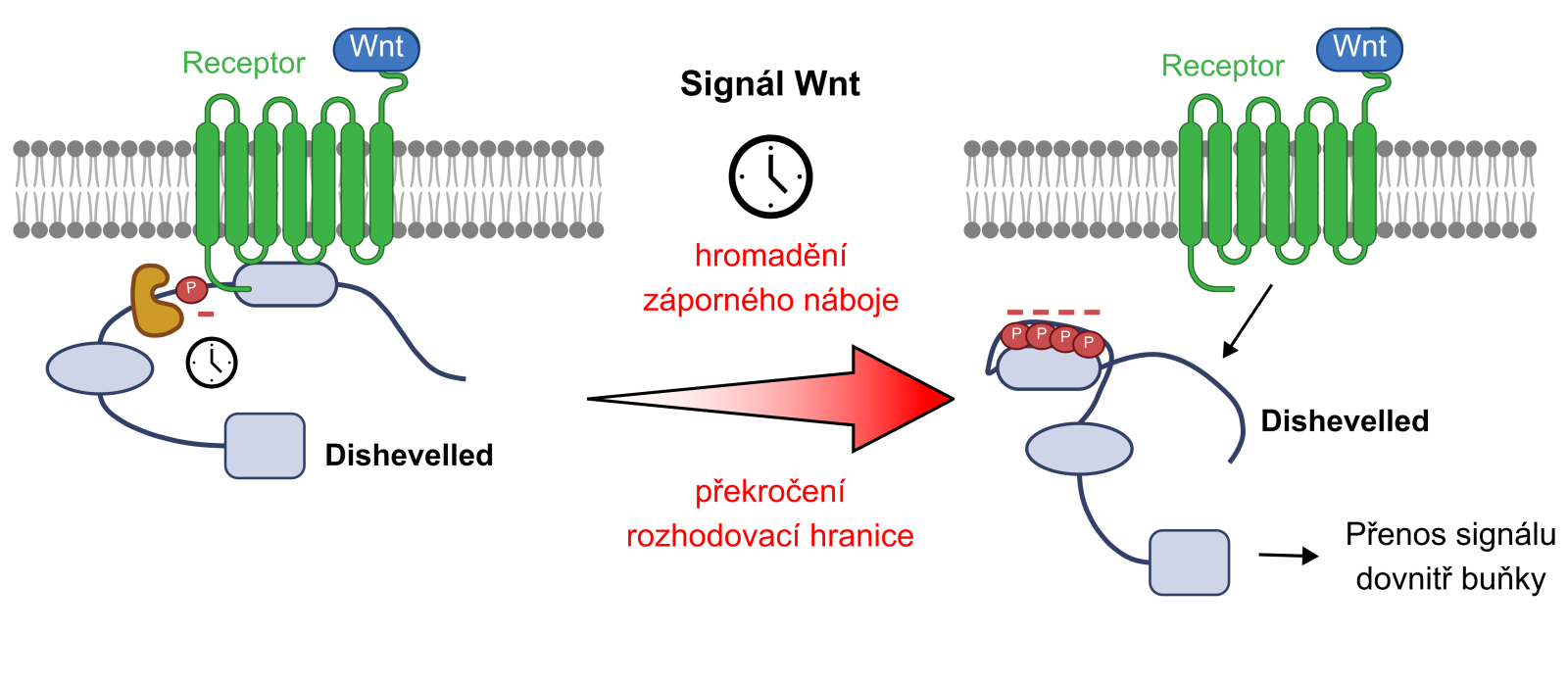
The process begins at the surface of the cell, where a signal is captured by a receptor embedded in the cell membrane. A protein called Dishevelled (DVL) then binds to this receptor and carries the signal further into the cell. However, for the signal to continue, DVL must first undergo a series of chemical modifications. Small chemical groups begin to accumulate on its surface, progressively increasing its negative charge.
And this is where the decisive moment occurs.
“We found that the DVL protein behaves like a switch – its structure changes abruptly once the negative charge on its surface exceeds a certain threshold. Only then does it rearrange and allow the signal to proceed further,” explains first author Miroslav Micka.
At this point, DVL detaches from the receptor, allowing the signal to move deeper into the cell. The cell then receives a clear instruction on how to respond – for example, to start dividing or change its function.
This crucial “tipping point,” where the fate of the signal is decided, has so far been only partially understood: “Scientists knew the pathway the signal follows, but they mostly viewed it as a gradual regulatory system. However, our teams have shown that it is rather a process based on decision points and abrupt changes once a certain threshold is crossed. This is important not only for understanding how cells function, but also for explaining what happens when these processes become dysregulated,” add corresponding authors Konstantinos Tripsianes from CEITEC MUNI and Vítězslav Bryja from the Faculty of Science.
Such decision points in cellular signalling are particularly important from a medical perspective, as their disruption can trigger processes that lead to tumour development. A better understanding of these processes, on the other hand, paves the way for more effective treatments.
The study was published in the journal Science Advances.
Photogallery
Author

Expert
