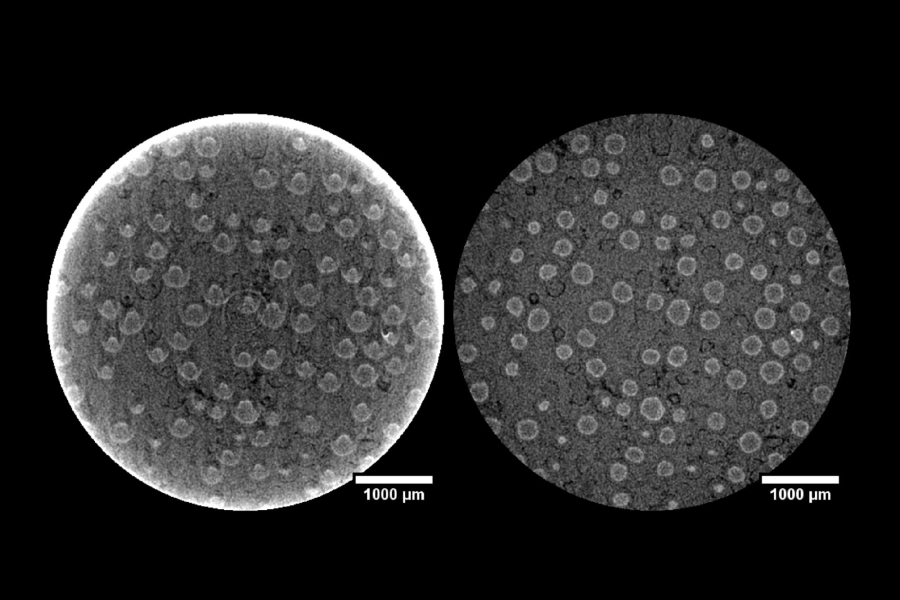
Tomographic reconstruction is the process of generating cross-sectional images from projections of a scanned sample and represents one of the fundamental principles of X-ray computed tomography. Data acquired by a CT scanner consists of numerous projections of an object captured from different angles, which are subsequently used to reconstruct its internal structure. Currently, two main types of reconstruction algorithms are used: analytical methods, characterized by high speed and computational efficiency, and iterative methods, which offer improved noise reduction capabilities and greater flexibility in terms of scanning geometry. Our research focuses on optimizing reconstruction techniques for high-resolution tomographic data. In collaboration with CT system manufacturer Rigaku, we also work on overcoming technological limitations of tomographic reconstruction, such as enabling the imaging of objects larger than the detector dimensions (Zemek, Student EEICT, 2020).
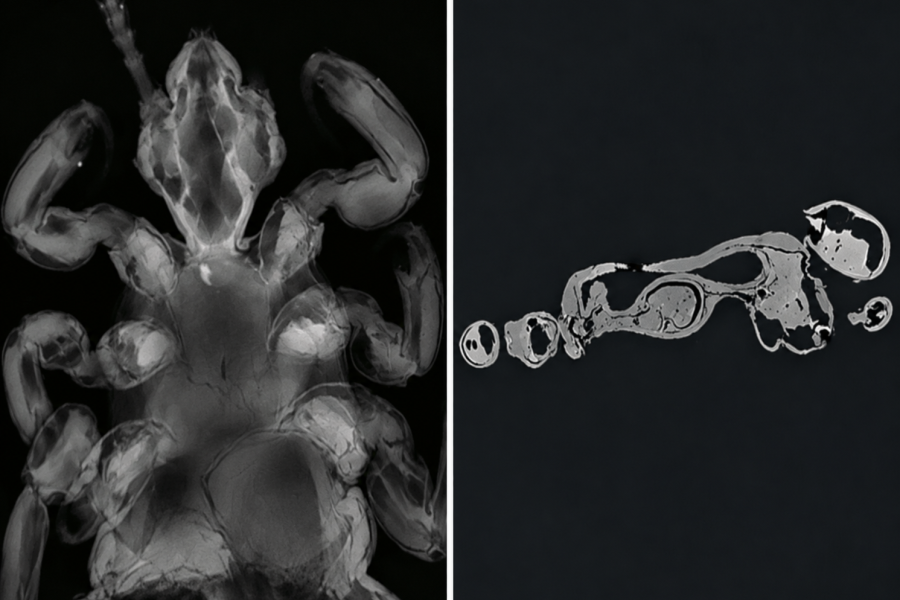
Artifacts are undesirable discrepancies between a CT image and the actual structure of the scanned object. In computed tomography, they most commonly appear as streaks, ring-shaped structures, geometric distortions such as doubled edges, or incorrect pixel or voxel values. These effects can significantly complicate accurate CT data analysis. Reducing or eliminating artifacts is a complex task, particularly when working with high-resolution CT data. Since artifacts can originate from various sources, specific correction methods must be selected according to their type and characteristics. Our research primarily focuses on developing methods for reducing ring and metal artifacts and suppressing noise in CT data.