

 Share
Share
13. Dec. 2021
An interview with Martina Říhová by Tereza Kadrnožková, editor of Události z VUT magazine.
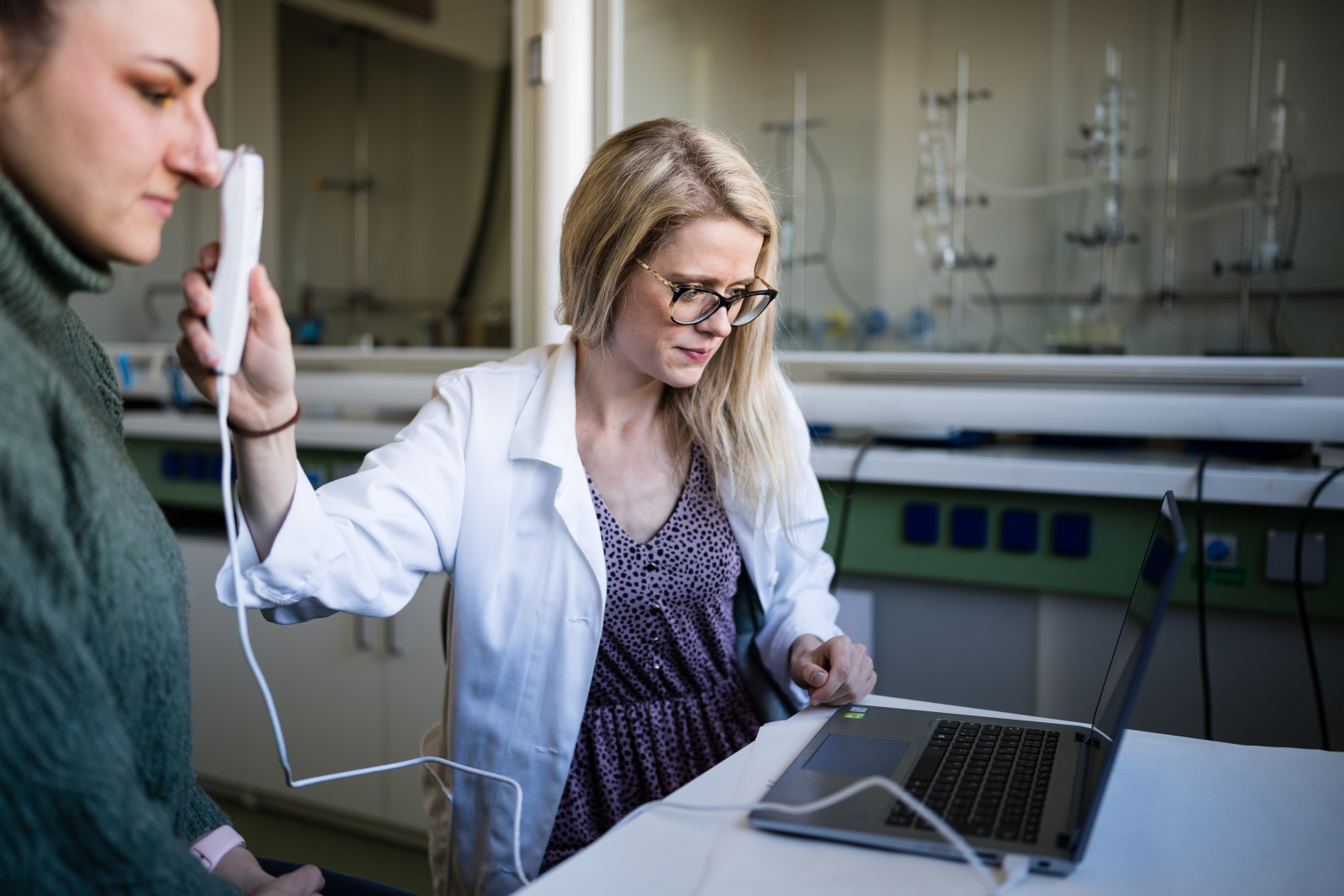
“I’m afraid you won’t be too pleased: you have enlarged pores. Here on the screen, you can see that they are considerably larger than the average for women your age. But you don’t have that many wrinkles,” reassures scientist Martina Říhová, who is now in her third year of developing sheet masks at CEITEC BUT. She places a skin analyser resembling a digital thermometer against my skin, and the computer screen immediately displays almost frighteningly magnified details of its imperfections. Enlarged pores are not only unsightly; they can also lead to blackheads and, subsequently, acne. The fact that I am far from alone in struggling with visible pores or acne is precisely what prompted the young researcher to explore cosmetics and dermatology.
With funding from the Technology Agency of the Czech Republic (TA CR), she has focused her efforts on researching fibre-based masks made from natural substances, working in collaboration with Pardam Nano4Fibers. “The material isn’t quite the same as the fabric used in shop-bought sheet masks. Ours is made from natural polymer fibres. It is better suited to this purpose than commercial masks because it contains no preservatives, emulsifiers, stabilisers or fragrances, which can cause rashes, for example, or harm the environment. When you apply commercial dermatological products to acne, some need to be left on for several hours to achieve the desired effect, and the skin cannot breathe during that time,” says Říhová, highlighting the advantages of the material developed at the Brno research centre.
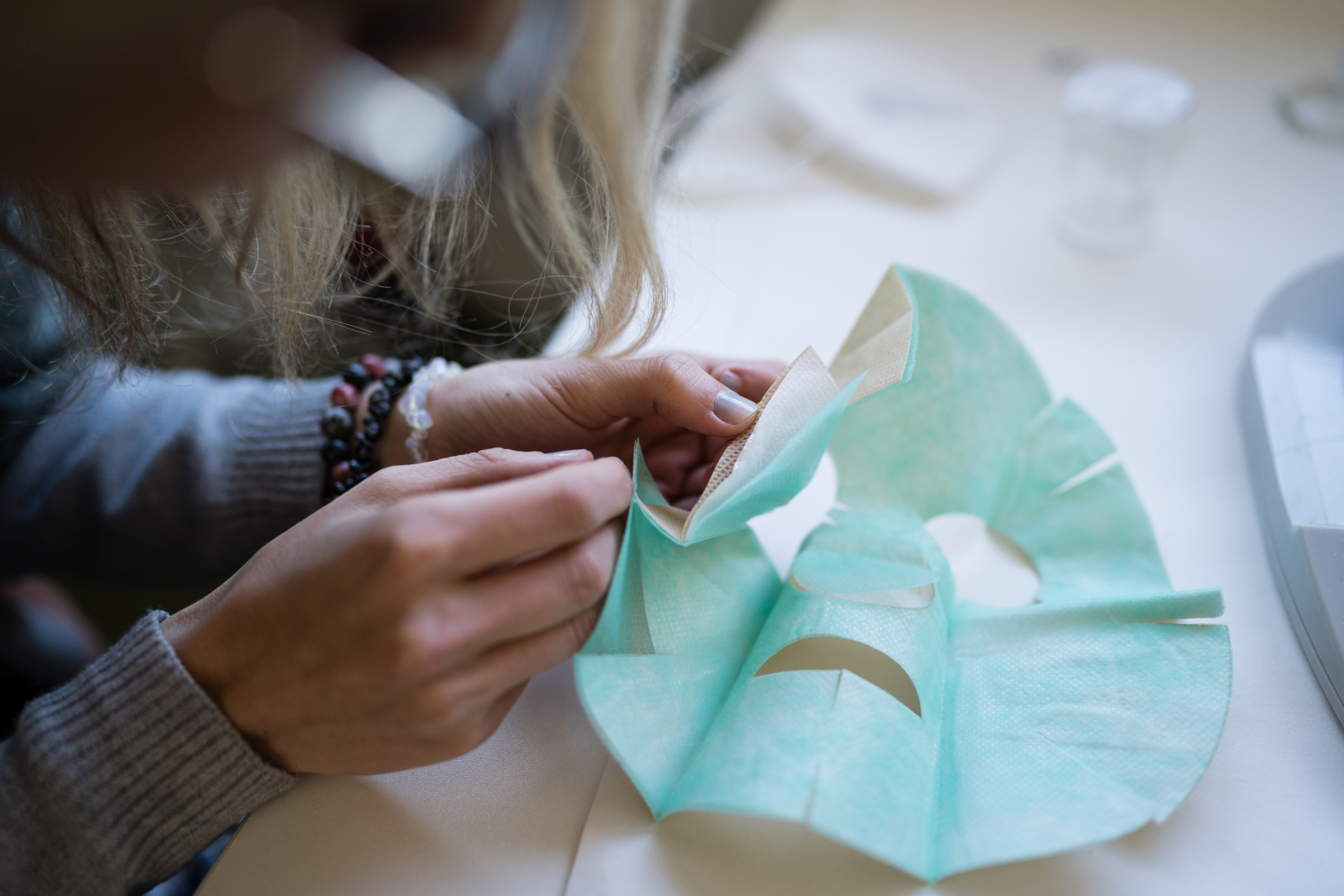
Their mask takes about ten minutes to work, allows the skin to breathe and leaves no marks on the skin, unlike some anti-inflammatory gels. It also eliminates the risk of introducing contaminants into a jar by repeatedly dipping your fingers into it. The fibre-based mask is not only single-use; it also dissolves completely: “The mask is made from water-soluble polymers, so all you need to do is moisten your skin with water, apply the mask, and you’re done in a few minutes.” It adheres well to the skin, so there is no need to sit still while it works. Although the thin layer resembles a commercial sheet mask, its distinctive structure becomes clear under an electron microscope. This reveals individual fibres similar to those used to make respirators or surgical masks. The fibre-based mask acts as a carrier for active ingredients intended to work on the skin. Vitamins E and C are added to address enlarged pores, while zinc oxide nanoparticles are incorporated for dermatological use on acne-prone skin.
Martina Říhová can also test the masks’ effectiveness directly in the CEITEC BUT laboratories. Some results are visible to the naked eye, while others are detected by the skin analyser. “Luckily, I have colleagues at CEITEC BUT who are happy to volunteer for testing. All I need is a computer and the analyser. I examine the condition of their skin before and after using the mask, focusing on the number of visible pores, acne, wrinkles and redness.” The researchers confirmed that the skin improved after the mask was applied, even if only for a few hours in some cases. As with almost anything, the key to better results is regular use.
At the start of her research, Martina Říhová compared her masks with readily available products. Today, she knows that the best mask is one she makes herself in the Brno laboratory, which she joined after studying at the University of Pardubice. “I studied chemistry-related subjects and enjoyed investigating natural materials. I was fortunate that Jan Macák was setting up a new team at CEITEC BUT and approached me. I’m originally from Jihlava, so Brno was an obvious choice. I’m very happy here: I have wonderful colleagues and access to modern facilities,” she says. Through the collaboration with Pardam Nano4Fibers, she has also been able to equip the laboratories with a specialised instrument that she uses in her current research.
“We produce our fibre-based masks using centrifugal spinning, which is comparatively more environmentally friendly, more cost-effective and technologically simpler than the conventional method. We make our fibres using the same physical principle that turns sugar into cotton candy. Our masks could even be cheaper than conventional masks currently on the market. What’s more, the raw materials we use, such as natural resins, are available all year round and worldwide,” the researcher says, emphasising the advantages of using natural substances.
Thanks to the collaboration with the company, she already knows there will be demand for her masks, including abroad. The know-how is therefore protected by an international utility model. This also helped Martina Říhová win this year’s Innovation Entrepreneurship Award, an internal competition recognising projects with the potential for practical application.
Photogallery
Expert
