

 Share
Share
27. July 2026
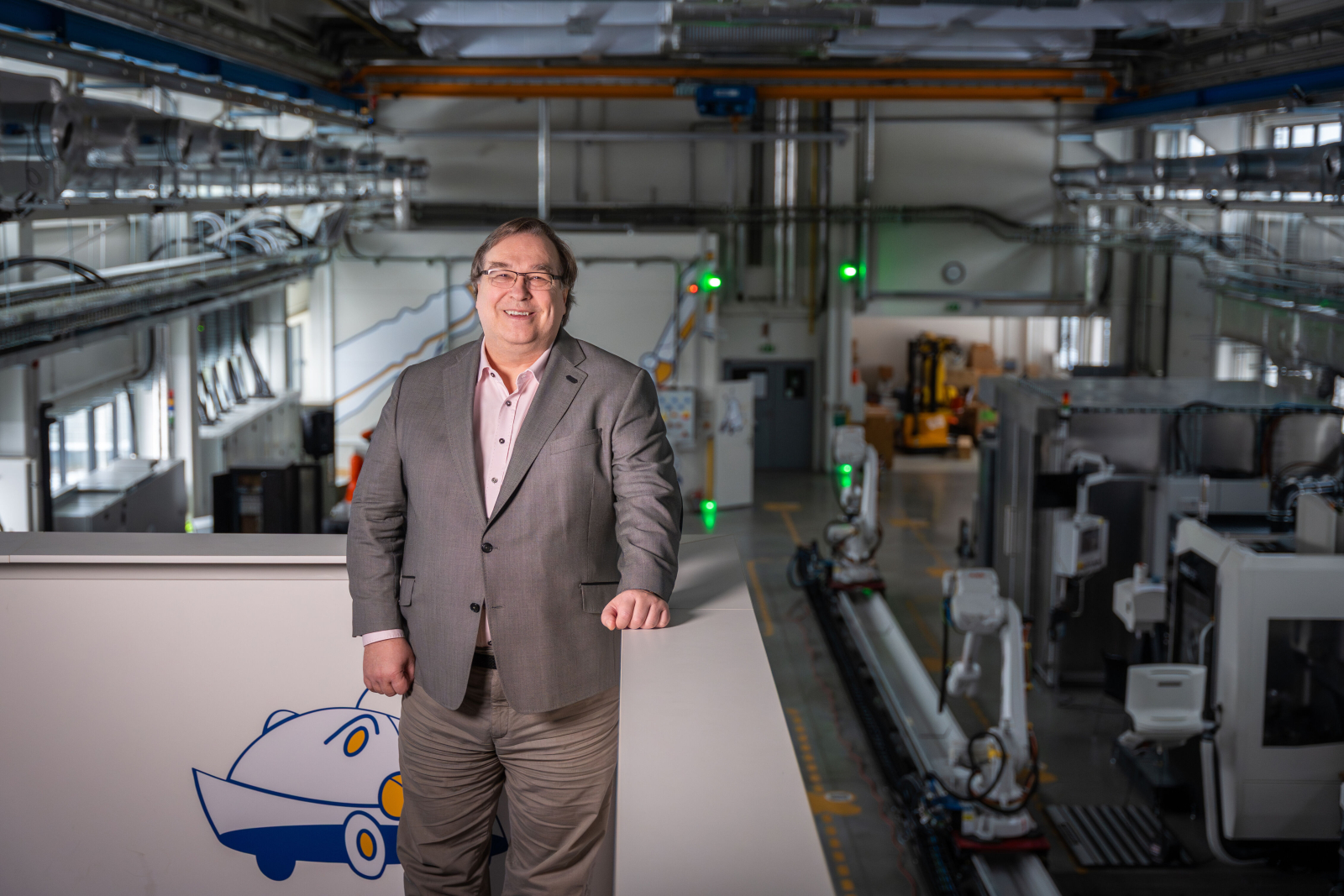
Society’s growing demand for the availability of all kinds of goods goes hand in hand with the idea of sustainability—or, in other words, maintaining a balance between using natural resources and protecting them. What began as a philosophical question of how to protect the environment without bringing economic growth to a halt has become a widely discussed topic in the media, permeating politics, industry, our everyday activities, and science. “However, for people to genuinely accept regulatory measures aimed at sustainability, they need to derive tangible benefits from them. This is one of the reasons why we, as scientists, work on projects that seek to deliver such benefits to the public,” says Pavel Václavek, head of the Cybernetics and Robotics Research Group at CEITEC Brno University of Technology.
When most people hear the word “sustainability”, they probably think of the circular economy or community activities affecting their immediate surroundings. However, the concept has many more interconnected dimensions. How should we understand it?
In today’s context, when we appreciate the uniqueness of our living environment more than ever before, I see sustainability as a way to do something for ourselves—save money or time—while also doing something for nature. We are working to reduce the energy intensity of production, automate manufacturing and predict machine failures, all of which ultimately delivers both economic and environmental benefits. We are also trying to promote electromobility, reduce CO₂ emissions in general and replace natural materials with synthetic alternatives so that we do not have to extract or import them. In this way, too, we are attempting to reduce the burden that our existence places on the planet.
There is another interesting perspective connected with this issue. In my opinion, the need for new materials is also crucial to national security and is closely linked to electromobility and academic research. Only scientific excellence will enable Europe to remain self-sufficient and avoid dependence for essential natural resources on countries with potentially despotic forms of government. This idea is therefore strategic from a geopolitical perspective and, in my view, represents one of the fundamental pillars of sustainability.
However, the idea that sustainability should also be viewed as part of national security has not yet been widely communicated to the public. Environmental and economic perspectives tend to dominate.
Yes, I believe this perspective needs to be discussed much more extensively in public. We need to acknowledge that key materials such as rare earth elements, copper and nickel are, for practical purposes, available only in China. Europe also imports oil and natural gas, so we are not fully self-sufficient in this area either, although we have made significant efforts to change this over the past few years. If we do not have alternatives based on readily available materials and a particular country turns off the tap for some reason, we will be unable to manufacture almost anything here.
As someone working in science, I believe we should systematically focus on developing substitute materials or entirely different technological architectures for industry and mobility. In the future, this could genuinely help us break free from our dependence on resources from unstable countries that use them not only as economic commodities, but also as instruments for strengthening their power in the geopolitical arena.
Brno University of Technology has been involved in this type of development from the very beginning. One example is the international MotorBrain project, which was launched back in 2011. Could you tell us more about it?
I remember that project very fondly because it was visionary in its essence. Even then, it addressed one of the fundamental—although at the time still somewhat overlooked—problems facing modern civilisation: the use of magnetic materials in electromobility.
The project had several objectives, but the main one was to develop a propulsion system for a fully electric car whose motor would not rely on rare-earth neodymium magnets, but instead on magnetic composites that are inexpensive and easy to manufacture. The problem is that, unlike small and energy-efficient neodymium magnets, these composites do not possess such favourable properties. It was therefore essential for us to find a solution that would allow alternative composite magnets to achieve the same performance parameters. And now, 15 years later, the issue is back on the agenda, with science once again searching for ways to eliminate rare-earth magnets from electric motors.
Your team has been conducting research into electromobility as one of the main areas of sustainability virtually continuously. What are you currently focusing on?
One example is the ARCHIMEDES project, which focuses on long-lasting power electronics. The electronic components and systems currently in use have a service life of approximately 8,000 hours, but future requirements are expected to be much higher—up to around 120,000 hours. The project therefore aims to develop components, models and methodologies that will collectively improve the efficiency and service life not only of electric propulsion systems, but also of energy-generation technologies and energy-storage systems used in the automotive and aviation industries. CEITEC’s role is to address the early diagnosis and prediction of faults in these electronic components and sensors.
Why is power electronics so important in the context of sustainability?
Because we need to find systems that are energy-efficient and cost-effective while not requiring frequent replacement. Everything in electromobility is interconnected. For example, when we replace mechanical brakes to reduce the release of abraded nanoparticles into the air, the electric motor needs to deliver more power while remaining stable over the long term. It could be said that improving performance and extending the service life of individual components are among the greatest current trends.
We are addressing this issue not only in electromobility, but also in production machinery. This is another reason why CEITEC is involved in another major area of sustainability: predictive maintenance. In the international R-PODID project, for example, we are developing an artificial intelligence-based diagnostic system that should be capable of detecting—and, most importantly, predicting—faults across larger groups of drives on production lines.
You said that sustainability should bring tangible benefits to people. What benefits can the much-discussed transition to electromobility offer them?
For ordinary users, one benefit is that electric vehicles are easier to maintain thanks to predictive systems and components designed according to different principles. However, it is not only about the impact on users; the advantages must also outweigh the disadvantages for manufacturers.
In the international Cynergy4MIE project, for example, we are working with our partners to create a unified technology platform that will facilitate the seamless transfer of intelligent software and efficient electronic components between different systems, accelerate product development, and reduce costs. This brings me back to my original understanding of the principle of sustainability. Cynergy4MIE aims to deliver economic benefits to manufacturers, while both this project and ARCHIMEDES should also offer genuinely tangible benefits to end users in the form of greater comfort. This is precisely when people will be able to embrace the idea of sustainability—when they see that it does not bring only regulations, but also real benefits such as greater convenience and longer product lifespans.
As part of your work on electromobility systems, you are now also involved in the large-scale European MOSAIC project. What exactly will CEITEC BUT focus on within this project?
The purpose of the project is to develop a range of new sensors for the automotive industry, robotics and infrastructure. These sensors will enable applications such as rapid data processing and intuitive decision-making supported by artificial intelligence. The project also places an emphasis on standardised communication protocols and system compatibility, which are crucial for industrial use.
Our institute is contributing to the project by developing a fibre-optic magnetic sensor for diagnosing electric drives. It will operate by detecting changes in the magnetic field and will be capable of identifying even the smallest irregularities in a motor’s operation.
Finally, how important is this particular project for CEITEC BUT?
Very important. MOSAIC is unique because it enables completely innovative research. Until now, research teams have addressed similar tasks using existing sensors that measure electric current in motor windings. Focusing on measuring changes in the magnetic field could therefore lead to a major technological breakthrough with considerable potential not only for diagnosing electric vehicle motors, but also other industrial equipment. I am pleased that CEITEC BUT has the opportunity to participate in developing a technology that could benefit not only manufacturers, but also the wider public in the future.
Author: Kristina Blümelová
Photogallery
Expert
