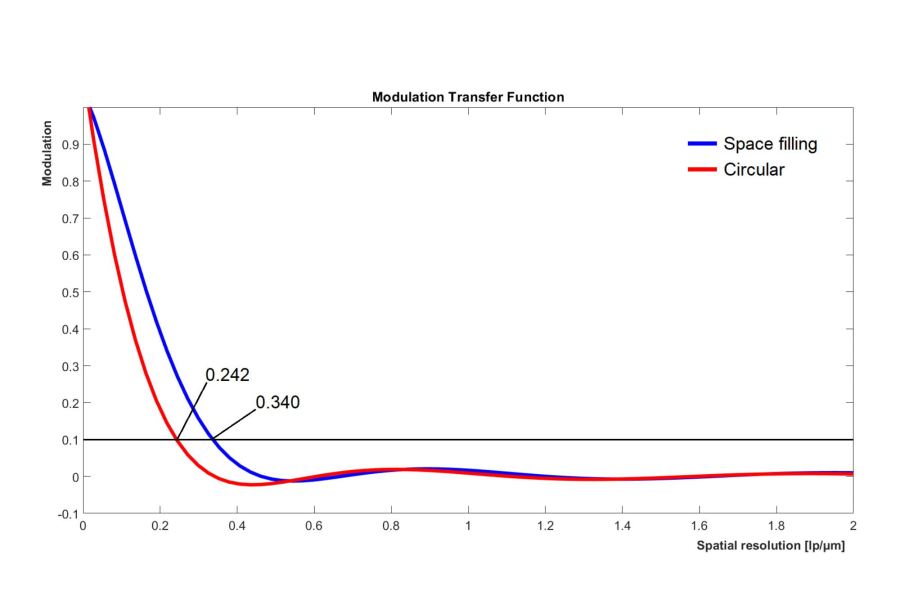
Spatial resolution is one of the key characteristics of CT systems, reflecting their ability to transfer spatial information from an object into the resulting image and distinguish fine details without blurring. Our laboratory focuses on researching and developing methods for determining spatial resolution through point spread function (PSF) measurements and spatial frequency analysis (Lázňovský J., 10th confiCT, 2020). We develop custom software for evaluating CT data in accordance with ASTM E1695 and design our own test phantoms. Calculations are based on the edge response function (ERF), point spread function (PSF), and modulation transfer function (MTF) (Rueckel J., Appl. Radiat. Isot., 2014). For practical testing, we also use commercially available phantoms, such as the QRM bar pattern and GIMA chart.
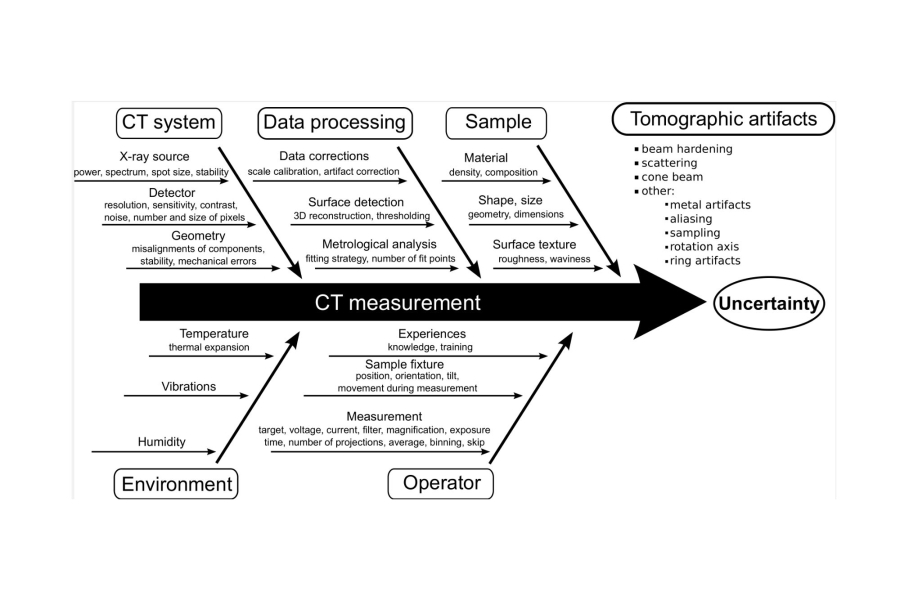
The CT measurement process is complex, and its results are influenced by numerous factors that limit measurement accuracy. The degree of this uncertainty is expressed as measurement uncertainty. Currently, no universal model can reliably account for all critical factors affecting a specific CT measurement task. Measurement uncertainty can be determined, for example, using the substitution method, in which repeated CT measurements are compared with reference values in accordance with the German VDI/VDE 2630 guideline. However, this approach is highly time-consuming and costly. Our research therefore focuses on systematically investigating individual influencing factors and developing a reliable model for determining CT measurement uncertainty.
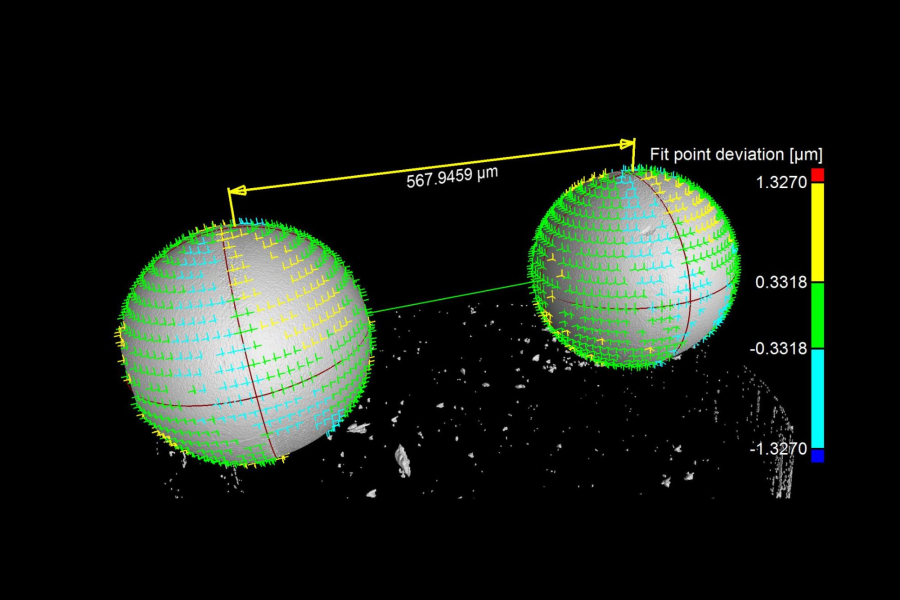
We develop new reference objects designed for CT system qualification, acceptance and verification testing, correction of error sources, and determination of measurement uncertainty using the substitution method. Reference objects commonly used for tactile or optical coordinate measuring machines (CMMs) are often unsuitable for CT, particularly due to their high X-ray absorption and the differences in measurement principles. CT metrology therefore requires specific materials with low X-ray absorption and high dimensional stability, such as aluminum, ceramics, crystals like ruby, or carbon fiber composites.