

 Share
Share
13. Oct. 2026
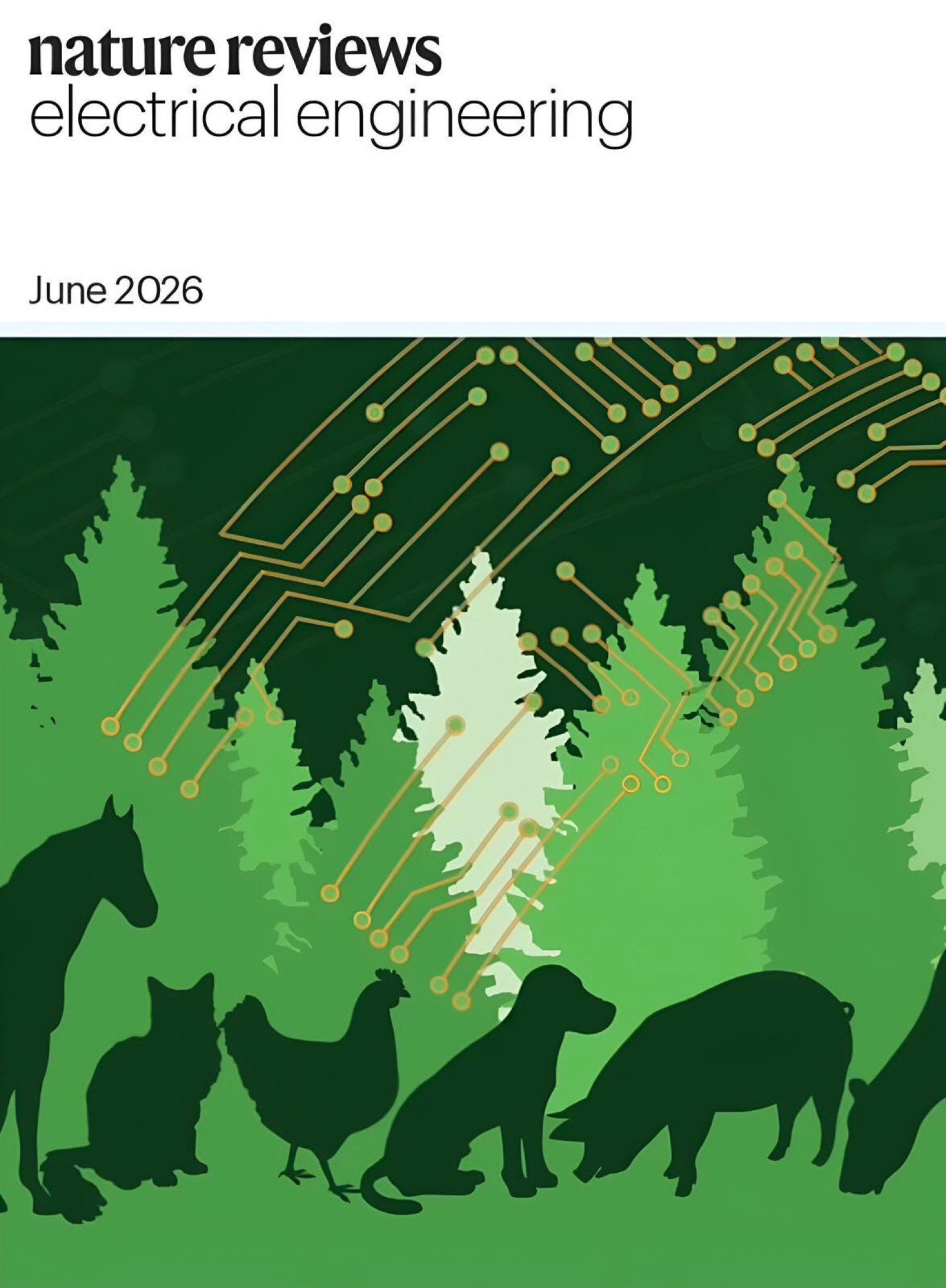
An electronic patch attached to a leaf can detect water shortage, infection or other signs of stress. A lightweight sensor worn by an animal can continuously monitor its vital signs, movement or changes in behaviour. Sagar Arya and Martin Pumera from CEITEC Brno University of Technology (BUT) explored the potential of flexible electronics for forest care and animal health in a review article published in Nature Reviews Electrical Engineering. The topic also featured in an illustration on the journal’s cover. Their team is developing similar devices in Brno.
Imagine animals and plants having their own “smartwatches” equipped with a range of sensors. Flexible, lightweight sensors attached directly to leaves, stems or animals’ bodies can collect long-term data on the health of individual organisms and the conditions in which they live. These data could help identify diseases and other risks early, improve forest protection and enable more targeted care for livestock and pets.
Flexible wearable electronics refers to miniature bioelectronic devices equipped with sensors and their own power supply. Their flexibility and thinness allow them to be attached to plant leaves and stems, as well as animals’ bodies. The review, which summarises current knowledge in this field, showed that further development of these devices is both technologically feasible and desirable, and is attracting increasing attention.
“We are greatly honoured that our article was published in such a prestigious journal—and that the editor selected it for the cover illustration, which features the issue’s most important article. We see this as confirmation that research into wearable electronics for nature and veterinary care has considerable scientific and societal potential. It is also highly attractive to industry, which will subsequently bring the results to market,” says co-author Martin Pumera, who also heads the Future Energy and Innovation research group at CEITEC BUT.
From protecting forests to reducing antibiotic use
Forest health is currently monitored mainly using drones, autonomous ground vehicles, laser mapping techniques, automated dendrometers and infrared thermal imaging cameras. However, rigid, invasive sensors can interfere with plant signalling and physiology, ultimately hindering accurate measurement. It is therefore essential to complement these methods with continuous, non-invasive monitoring of plant health and the surrounding microenvironment.
“Only by combining conventional methods with non-invasively collected information on temperature, humidity, movement, vital signs or chemicals released by an organism can we obtain a more reliable picture of its health. Specialised algorithms using artificial intelligence can evaluate these data and flag unusual changes,” explains the study’s lead author, Sagar Arya.
According to Arya, the findings could help guide targeted forest care and prevent deterioration caused by the spread of wood-decaying fungi or other pests. Information on plant hydration and environmental conditions could also contribute to more accurate assessments of fire risk. In agriculture, similar technologies could enable more targeted irrigation, reduce unnecessary pesticide or antibiotic use, and provide data to support the breeding of more resilient crop varieties.
Martin Pumera’s team in Brno has also been researching these devices for many years. It is currently developing, for example, a soft sensor patch for plant leaves to monitor their hydration and temperature. A sensor for monitoring livestock health, designed as a lightweight, flexible collar, is also being developed in CEITEC’s laboratories.
Technological challenges on the path to deployment in nature
The review summarises current findings from research teams around the world. Many of the devices described are still prototypes or are undergoing practical testing. Before sensors can be deployed on a large scale in forests, for example, researchers must address their long-term durability, reliable wireless data transmission, power supply, and the environmental impact of the materials used.
One option is to develop devices that generate the energy they need through flexible solar cells or harvest it from movement and vibrations. Algorithm reliability, data protection and the establishment of common technical and safety standards will also be important.
“Flexible electronics has considerable potential for health monitoring and disease prevention, offering new solutions to support global well-being. With a sustainable future in mind, it is essential to recognise that the health of forests and animals is equally important and deserves access to advanced technological solutions,” concludes Martin Pumera.
The article Flexible electronics for forest and veterinary health monitoring was published on 12 May 2026 in Nature Reviews Electrical Engineering. The editorial team also selected its topic as one of the main themes of the journal’s June issue.
Author: Kristina Blűmelová
Photogallery
Expert
