

 Share
Share
18. June 2026
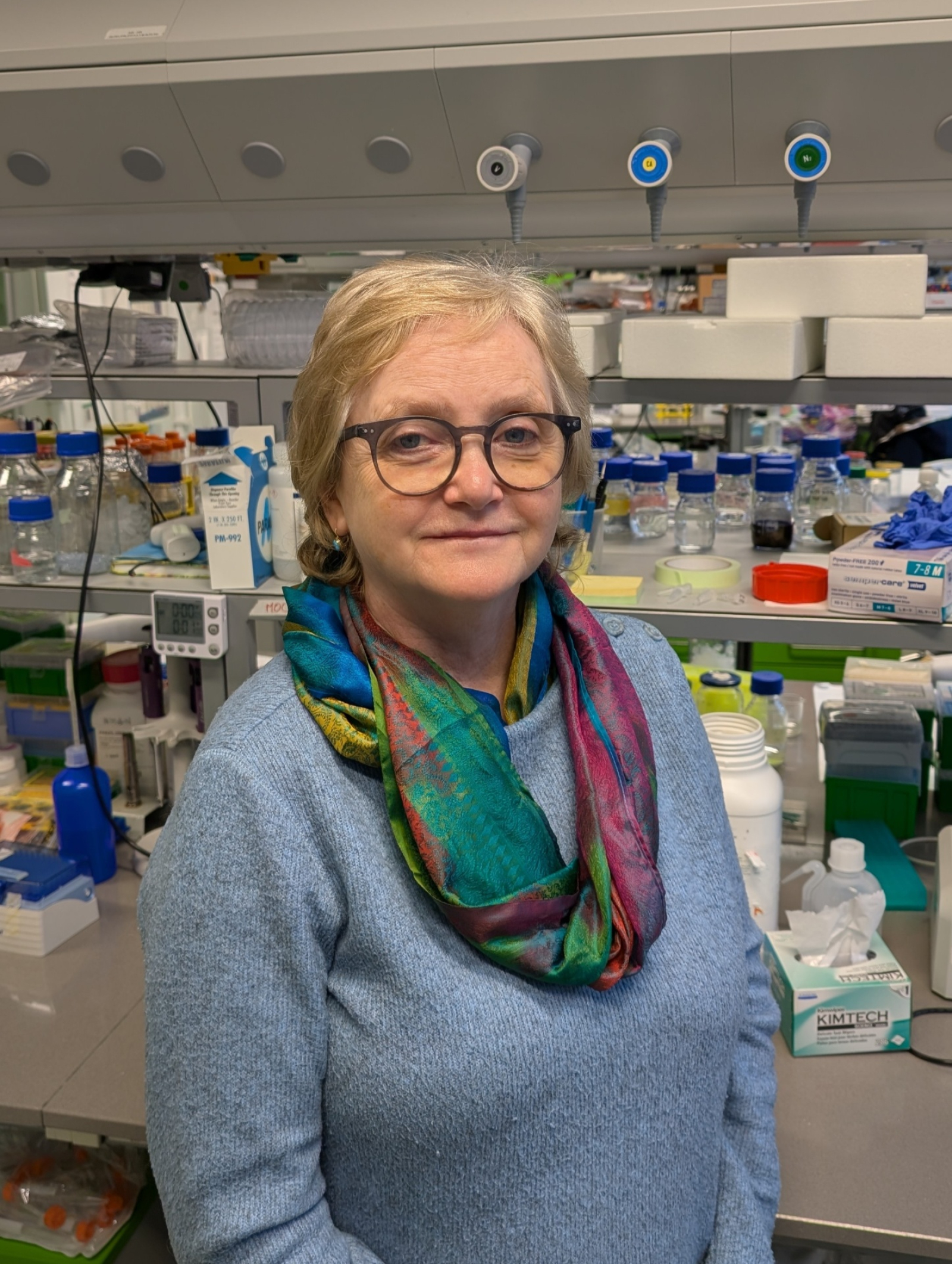
Professor Mary Anne O’Connell has spent decades at the forefront of RNA biology, helping uncover how cells distinguish their own RNA from foreign genetic material. Her research on ADAR enzymes and RNA editing has shaped our understanding of immunity, inflammation, and the future of RNA-based therapies. Before joining CEITEC Masaryk University, she worked in research institutions across the United States, Switzerland, Sweden, and the United Kingdom. In this interview, she reflects on scientific turning points, the emotional realities of leading a research group, the evolution of RNA research, and the importance of resilience – in science and in life.
You originally worked on microbiology before moving into RNA research. How difficult was that transition, and are such shifts common in scientific careers?
Quite naturally, actually. During my PhD, HIV was emerging in New York, and many people from my generation moved into retrovirus research because it felt urgent and important. I worked at Albert Einstein College of Medicine in New York, where some of the first HIV cases appeared at the neighbouring large hospital. Therefore, I went to MIT to do a postdoc with Nancy Hopkins, who was a leader in the field of murine retroviruses.
Then my husband wanted to return to Europe, to Switzerland in particular. I found a position in the laboratory of Walter Keller in the Biozentrum in Basel and had an opportunity to study RNA and viruses. I took that position — though I never worked on viruses, I began my research on ADAR enzymes.
In science, these shifts happen often. Careers are shaped not only by curiosity, but also by circumstances; timing, funding, countries, and family. Often the path only makes sense in retrospect.
Was there a particular moment when you realised you had chosen the right career?
Yes. After my PhD, I wasn’t sure I wanted to stay in science. I travelled alone through Nepal and India and did the Annapurna trek. When I came down from the mountains, I picked up The Herald Tribune. The first thing I read was a science article, and I remember thinking immediately: “Okay. This is it.” It sounds strange, but that was the moment. It felt as if the universe was quietly pointing me in the right direction.
How would you explain RNA editing and ADAR enzymes to a non-specialist?
DNA is the genetic blueprint of our cells. RNA is the intermediate step between DNA and proteins.
For a long time, scientists thought RNA simply copied information from DNA. What our field discovered was that RNA itself can be modified and edited. The protein we study, called ADAR, modifies RNA to help the cell distinguish between its own RNA and foreign RNA from viruses or bacteria. This is essential because cells constantly encounter bacterial and viral RNA, and they need a way to recognise what belongs to the body and what could be dangerous.
Our cells modify their own RNA to mark it as “self”. Without these changes, the immune system may mistake the body’s own RNA for a pathogen and launch an immune response against itself. Often, this immune reaction is more dangerous than the infection itself.
So, RNA modification is not just a small molecular detail – it is essential for survival.
How has the understanding of RNA changed over the course of your career?
Completely.
When I began, RNA was viewed mainly as a messenger between DNA and proteins. Today it is at the centre of biology and medicine. RNA vaccines changed public awareness of the field, but RNA also influences immunity, inflammation, development, and many diseases. Every few years the field reveals something unexpected. This is also why so many companies are now developing RNA-based therapies, particularly for cancer, where they could help the immune system recognise and fight tumour cells more effectively.
You believe RNA-based therapies could change cancer treatment in the future?
Yes, I genuinely believe they will.
The idea is elegant: you sequence a patient’s tumour, identify what makes it unique, and design an RNA-based therapy that trains the immune system to recognise those tumour-specific markers. Of course, this does not mean there will one day be a single universal cure for cancer. Cancer is extremely diverse, with many different forms and mechanisms. But personalised RNA-based therapies have enormous potential because they can be tailored to the specific features of an individual tumour. In the future, treatment could become much more systematic – doctors may one day analyse the tumour sequence and select the most effective therapy from a kind of catalogue of targeted RNA-based treatments.
And none of this would exist without basic research. The discoveries that later change medicine usually begin as curiosity-driven science.
What brought you to CEITEC Masaryk University in Brno?
At the time, I was working at the Medical Research Council in the UK. Our research funding was cut just before the RNA modification field exploded. We lost funding by a single point in the evaluation of our future proposed projects. We proposed to investigate other types of RNA modification in the 3’UTRs of RNA and to determine how ADAR1 was essential for innate immunity. These are now two major research areas.
That experience taught me what “cutting-edge science” really means. People love that phrase, but they often forget what it really means. If you are at the cutting edge and funding suddenly contracts, you are the first to be cut off.
Then the ERA Chair position at CEITEC opened. I applied, got the position, and arrived in Brno just as both of these research fields were becoming ‘hot’. Scientifically, the timing to move here could not have been better.
What do you like most about Brno?
I really love living here. Brno has changed enormously during the ten years I’ve lived here. When I first arrived, you barely heard English on the tram. Now you hear many languages everywhere. It has become much more international and cosmopolitan, but it still feels manageable and human.
I also think the city has become more self-confident. Earlier, people constantly compared Brno to Prague. Now it feels more comfortable being itself. And honestly, the quality of life here is very good.
My only real complaint is the airport. But, the cost of living is lower than in many Western European cities, the city centre is beautiful, and you are geographically in the middle of Europe.
What have you learned about leading a research group?
Nobody teaches you how to lead people. I was lucky because I started with a small research group and gradually learned how to manage people over time. I actually think it can be difficult when scientists that are just starting suddenly have large groups, because managing people is a completely different skill from doing science itself.
What has changed enormously over the years is the level of anxiety and stress among younger researchers. I suspect social media plays a role. People constantly compare themselves to unrealistic versions of other people’s lives and careers and feel pressure to succeed in every aspect of life at once. My generation did not have this pressure.
When people struggle personally, it immediately affects their research because they cannot think clearly or focus properly. As a group leader, you are no longer only supervising science – you are also trying to support people emotionally. Over the years, I’ve also learned that you cannot solve everything for everyone. Some people accept help and advice, and some do not. That can be difficult, but it is part of leadership too and you have to accept it.
In connection with the International Day of Women and Girls in Science, you mentioned resilience as something women bring to science. Can you expand on that?
Resilience is essential in science. Experiments fail. Funding disappears. Papers get rejected. Personal situations become complicated. You cannot survive in research without resilience.
I think many women place enormous pressure on themselves. They compare themselves to impossible standards and feel they are failing. You have to accept that life moves in phases. During difficult periods, you simply keep going.
What was the most challenging period in your career?
Probably after we lost our funding in the UK. My children were teenagers at the time, and I moved to Sweden for work before eventually coming to Brno. I spent years travelling back and forth every second weekend. Scientifically, the work was worth it. Personally, I missed years of my children growing up.
That’s one of the difficult realities of science: decisions that are scientifically right can still be personally painful.
At the same time, that period also taught me a lot about people and kindness. I have always been amazed by the random kindness of strangers. People whom I expected to help me often did not. Meanwhile, people to whom I had simply been kind – without expecting anything in return – were often the ones who helped me most, later in life. My advice is to be kind to everyone, don’t expect people to reciprocate, but that your kindness to others will comes back in unexpected ways.
Finally, what advice would you give to your younger self?
There is a quote by the Irish poet Seamus Heaney that I love: “Walk on air against your better judgment.” To me, it means: just go for it.
You only have one life. Try things. Take risks. Sometimes the irrational decisions become the most important ones you ever make.
Photogallery
Author

Expert
