

 Share
Translation control
| Supervisor | Petr Těšina, Ph.D. | 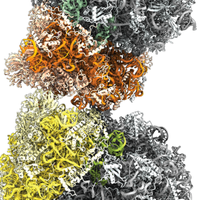 |
| Research Group | Translation Control |
Age-related neurodegenerative diseases present a major global health challenge. A fundamental unresolved question is how translational stress disrupts protein synthesis in neurons, causing ribosomes to stall and collide, creating molecular “traffic jams” that threaten cellular proteostasis. Neurons respond through collision-sensitive surveillance pathways, including an early translational repression mechanism that acts as a brake by limiting further ribosome loading onto affected mRNAs.The project will define this protective response from the atomic mechanism to its organization inside intact neurons using two complementary structural approaches. First, single-particle cryo-EM will determine the high-resolution structure of the translational repression complex on collided ribosomes, revealing the interfaces that couple collision recognition to translational repression. Second, cryo-electron tomography will visualize the native three-dimensional translational landscape of stressed neurons and map ribosome states and collision-associated assemblies across the soma, dendrites and axons.Together, these approaches will provide a multi-scale structural framework for understanding how neurons reorganize translation during acute translational stress and how failures in collision-responsive surveillance may contribute to neuronal vulnerability in ageing and neurodegenerative disease.
See list of topics
- 4D In-Vivo X-Ray MicroCT for Longitudinal Imaging of Coral Biomineralization and Skeletal Dynamics
- Additively Manufactured Sensors for Crop & Plant Health Monitoring
- Advanced Software for Batch Processing of Correlative Imaging with Quantitative Phase and Fluorescence
- Assembly and Maturation of Flaviviruses
- Cell Entry and Genome Delivery of Non-Enveloped Viruses
- Design Principles of Fusogenic Proteins for Lipid Vesicles
- Development of Advanced MRI Techniques for Functional Brain Mapping
- Development of Multimaterial 3D Printing Using the Digital Light Processing Method
- FAST-4D hiQPI: Fast, Accurate, Scalable, Time-Lapse 4D Holographic Incoherent-Light-Source Quantitative Phase Imaging
- Frascan II: Methods and Applications
- How Whole-Genome Triplication Shaped Desert Adaptation in Brassiceae
- Integrating Osteological and Biomolecular Evidence to Investigate Chromosomal Aneuploidies in Past Populations
- Laser- and Plasma-Assisted Dry Synthesis of Graphitic Micro-Patterns for Bioactive Cell Interfaces
- LIMA: LIBS Integrated Mineral Analyzer for Automated Mineralogy and Quantitative Elemental Prediction
- Lipid Nanoparticles in Drug Delivery
- Magneto-Structural Properties and Quantum Phenomena in Molecular Materials
- Method Development in Palaeoproteomics
- Molecular Magnetic Materials for Quantum Spin Control and Emerging Quantum Technologies
- Next-Generation Anticancer Therapies Based on Metallodrugs
- One Protein to Rule Them All: Decoding the Multifunctionality of Paramyxovirus Matrix Proteins
- Pushing the Frontiers of Magnetic Resonance Spectroscopy for Biotechnology and Materials Engineering
- Quantum Correlations in Free-Electron–Photon Interactions: Theoretical Foundations and Experimental Protocols
- Regulation of Drought Stress Memory and Resilience in Brassica napus Plants
- Retrogene Evolution in Brassicaceae: The Roles of Genomic Context and Polyploid History
- RNA-Associated Mechanisms in Polycomb-Mediated Epigenetic Silencing
- Single-Atom Catalysts for Sustainable Ammonia Production
- Structural Basis of Pathological Tau Recognition and Early Aggregation in Tauopathies
- Theoretical Investigation of Magnetic Molecules Supported on 2D Materials and Nanostructures Using Advanced Quantum-Chemical and Molecular-Modelling Methods
- Tracing Brain Disease Back to Developmental Decisions
- Translation Control
- Tunable and Robust Charge Injection Layers